



Accompong News Network
In the limestone hills of western Jamaica, where the Cockpit Country folds into ridges so sharp the British Empire once called them impassable, a 288-year-old sovereignty is running its own intelligence service.
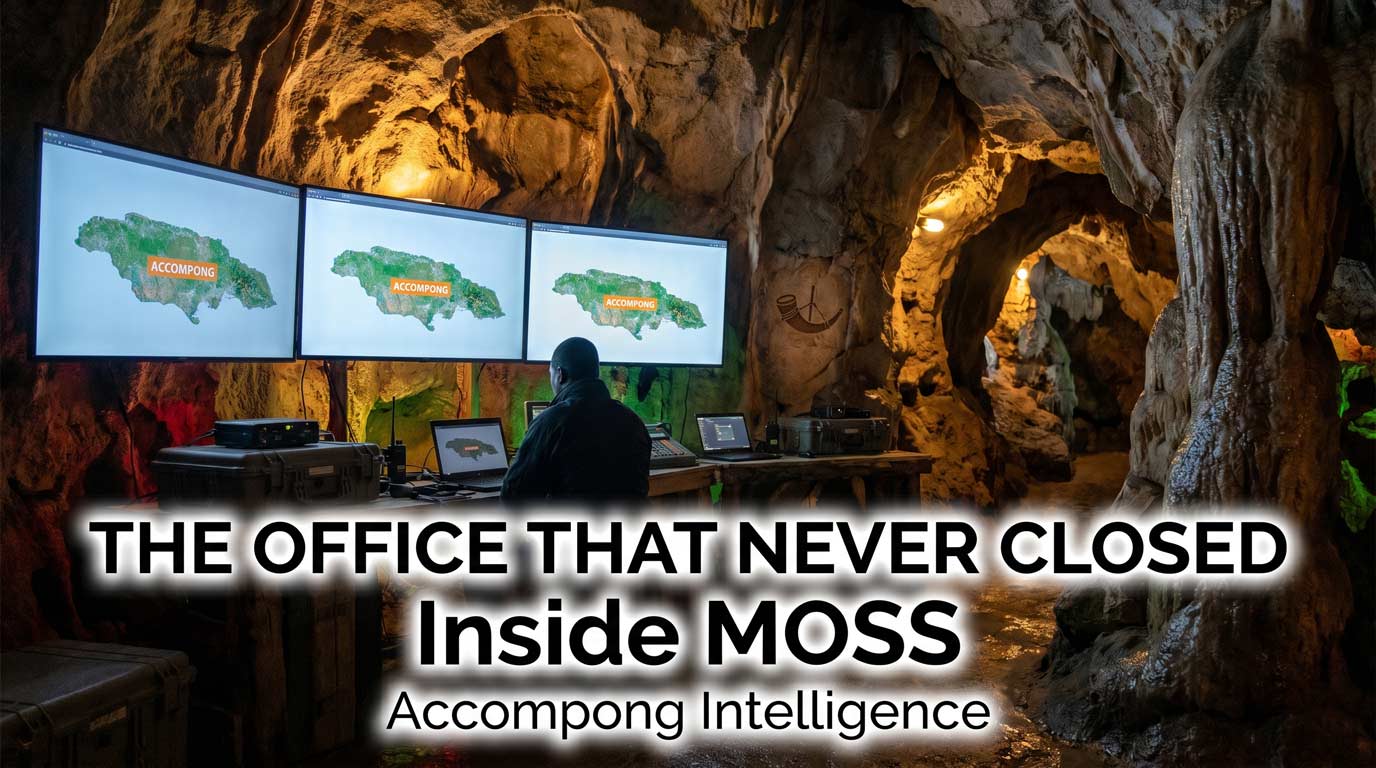
It’s called MOSS — the Maroon Office of the Secret Service. And in April 2026, it went public.
The Treaty
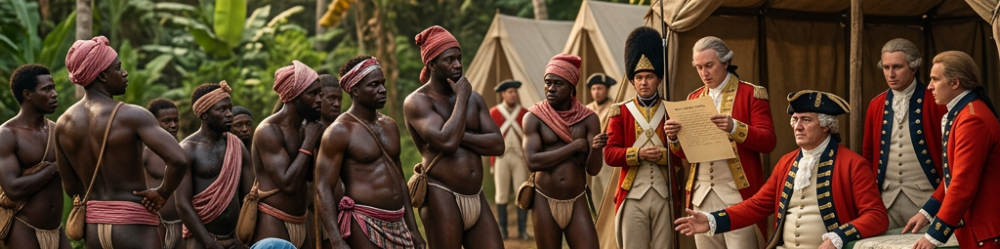
The story begins in 1738. After decades of guerrilla war in the mountains of Jamaica, Colonel Cudjoe and the British Crown sat down under a cotton tree — later known as the Kindah Tree — and signed a treaty. Not a pardon. Not a grant. A treaty between two parties at war, in which the losing side was the Empire.
The Treaty of Peace and Friendship did four things, each with the word forever attached. It ended hostilities permanently. It declared the Maroons in a perpetual state of freedom. It granted them territory for themselves and their descendants. And it established a line of command from Cudjoe through his brother Accompong and onward.
The Maroons had fought for their freedom. The treaty simply recognized what they had already won.
The State of Accompong has existed continuously from that moment to this — administering its own council, maintaining its own offices, governing its own affairs. It is not a historical curiosity. It is a functioning sovereign entity whose institutions predate the United States Constitution by half a century.
Man O. Rowe and the Founding of MOSS
In 1923, a 20-year-old named Henry Octavius Rowe — known as Man O. — created an office to protect what the treaty had established. He understood something that bureaucracies take centuries to learn: a state without a record is a state that can be rewritten.
Treaties can be misquoted. Boundaries can be moved on paper before they’re moved on the ground. Identity itself can be borrowed, forged, or sold.
Rowe called his office MOSS. He would go on to serve as Secretary of State of the Accompong Maroon Council for the better part of the 20th century. Throughout that time, MOSS held custody of the treaty, the state’s documents, and its institutional memory.
MOSS was not a police force. It was not a military unit. It was the office that watched, verified, and preserved.
When Rowe died in 2006, the office went dormant. For eight years, the seat was empty.
The Thread That Pulled MOSS Back
The thread that pulled MOSS back into existence was a person, not a policy.
Dr. Vivien Cornish, the granddaughter of Man O. Rowe himself, was still alive. Still in Accompong. Still a living witness to the lineage of the office her grandfather had built. The connection to the founder was not historical. She was standing in the room.
On July 1st, 2014, David Errol of the Family Holmes accepted appointment as Secretary of State under the authority of Colonel Ferron Williams. The ceremony was held in Accompong Town with Dr. Cornish present, photographed alongside Holmes, Colonel Williams, and Council Member Mark Wright for the record.
Coming Into the Light
For years, MOSS worked quietly — gathering information, maintaining records, watching.
Then in February 2021, Richard Currie was elected Colonel of the Accompong Town Maroons. Shortly after taking office, he did something no chief had done before. He publicly thanked MOSS by name.
Colonel Currie acknowledged that MOSS, led by Dennis Foster, former Secretary of State David Holmes, and Duncan Buchanan, had contributed significant intelligence to the Office of the Chief. That intelligence led to revelations regarding the previous administration’s operations, including collusion with external forces behind what was being described as the official currency of the Maroon people — the Lumi.
It was the first time MOSS had been acknowledged on the record by a sitting chief as a functioning intelligence operation. The quiet office that Man O. built to keep records had done what it was designed to do. It had watched. It had gathered. And when the state needed the information, it delivered.
What MOSS Does Now
MOSS operates under four pillars: sovereign standing, service to the state, records and verification, and standing guard.
Its authority chain runs from the 1738 treaty through the state itself to the office founded in 1923 and reestablished in 2014. The office is registered under seal with the International Labour Organization, the UN body responsible for ILO Convention 169 — the binding international treaty on the rights of indigenous and tribal peoples — with authentication certified by Global Affairs Canada in 2019.
The office does not make arrests. It does not conduct law enforcement. It gathers intelligence, manages information, and defends the integrity of the state’s standing against four categories of threat:
Financial schemes that trade on the Maroon name. Environmental and commercial threats to Cockpit Country. Misrepresentation of the treaty and its terms. External and cyber threats, including impersonation of state offices and disinformation.
April 2026: MOSS Goes Public
In April 2026, MOSS did something it had never done before. It launched a public website and stepped into the open.
After a century of operating behind the scenes — first under Rowe, then through the 2014 reestablishment, then through the quiet intelligence work that surfaced in Currie’s 2021 address — the office made itself visible to the world.
The site laid out the full architecture of the office: its authority, its chain of command from the 1738 treaty to the present day, the text of the treaty itself article by article with plain language commentary, a formal threat assessment covering four categories of danger to the state, and a channel for the public to report concerns.
For the first time, anyone — the diaspora, the press, foreign offices, financial institutions — could see what MOSS was, what it did, and where its authority came from.
It was a declaration made in public that the office was no longer just watching from the shadows. It was standing in the open, under its own name, under its own seal.
For the Born and the Unborn
The motto of MOSS says it plainly: For the born and the unborn.
It is a statement about continuity — that what was established in 1738 is not a relic but a living obligation, held for the people who are here now and the generations that haven’t arrived yet.
What Man O. Rowe built at 20 years old was a declaration that a sovereign people will keep their own records, guard their own standing, and answer to no one but themselves. What was reestablished in 2014 was the infrastructure to make that declaration function in the modern world.
The office endures.