





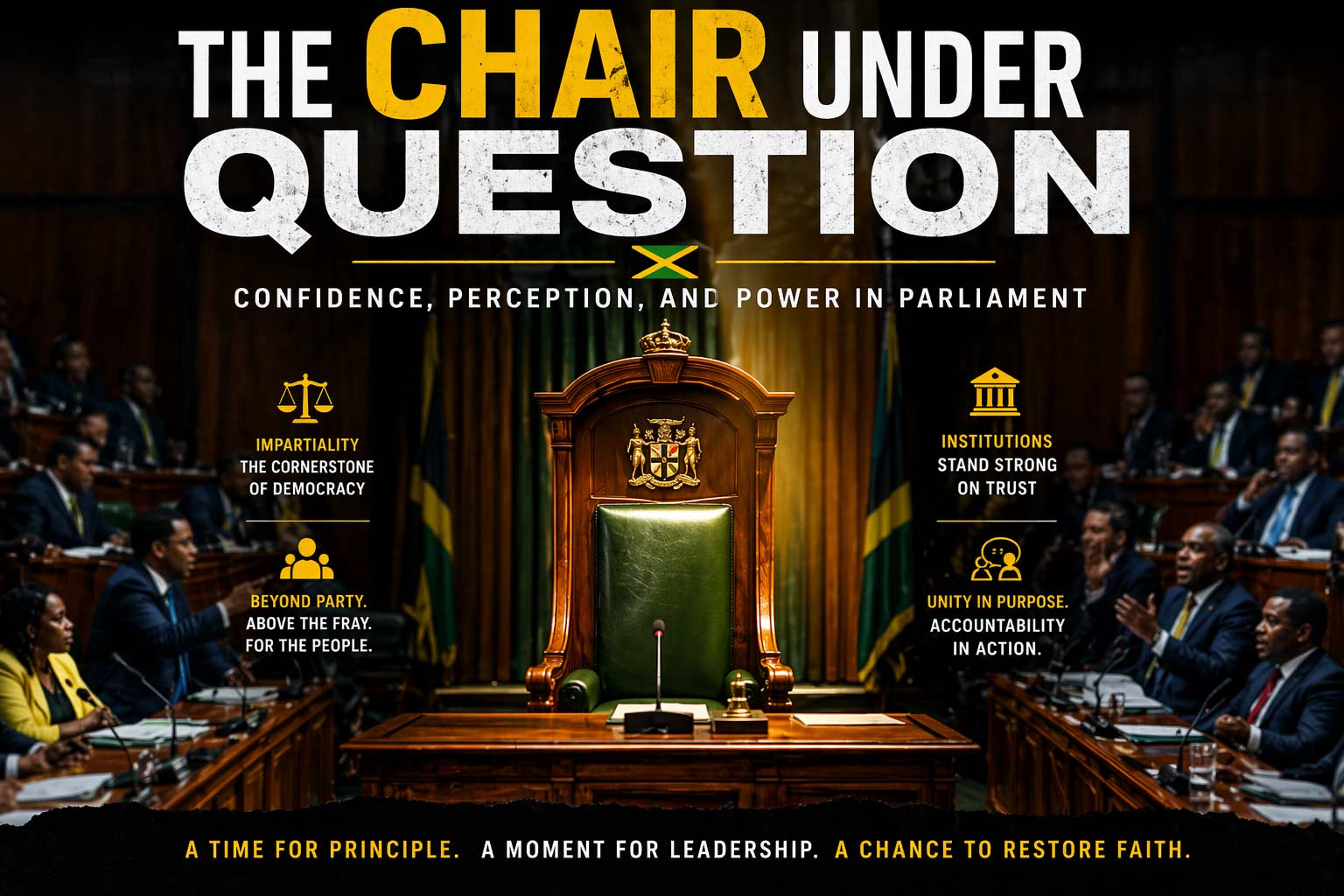
In any mature Westminster-style democracy, the Speaker of the House of Representatives must stand above the fray – a neutral arbiter whose rulings command respect from both sides of the aisle. When that impartiality, or even the perception of it, comes under sustained challenge, the institution itself suffers. Jamaica’s Parliament is currently confronting precisely such a moment.
Recent weeks have seen growing unease over the conduct of Speaker Juliet Holness. Opposition Leader of Business Phillip Paulwell has publicly urged her to withdraw from parliamentary committees in which she sits as an ordinary member, arguing that her participation risks blurring the essential line between the Speaker’s role and partisan engagement. Accusations of favouritism – from muting microphones to curtailing debate – have echoed across the chamber, culminating in Opposition walkouts. These are not mere procedural spats; they erode the confidence that every Member of Parliament must have in the Chair if the House is to function effectively.
The situation is compounded by an unavoidable reality: Speaker Holness is married to Prime Minister Andrew Holness. While her initial election followed proper parliamentary procedure, the optics of a spouse presiding over debates involving her husband’s government have always been delicate. In politics, perception frequently carries as much weight as strict legality. When every contentious ruling is inevitably viewed through a partisan lens, the office risks losing the broad respect it requires to command authority.
This is not a call for resignation on grounds of illegality – no such breach has been established. Rather, it is a recognition that the credibility of the Speakership is too vital to be left vulnerable to persistent doubt. The dignity of the office demands proactive steps to restore trust, and if those steps prove insufficient, Parliament should look to a successor who can command cross-party confidence.
One name stands out as particularly well-suited to restore faith in the Chair: the Honourable Marlene Malahoo Forte, Member of Parliament for St James West Central and former Minister of Legal and Constitutional Affairs.
This week, during the debate on the critically important National Reconstruction and Resilience Authority (NaRRA) Bill 2026 – legislation that will channel billions of dollars into post-Hurricane Melissa recovery – Malahoo Forte delivered a courageous and principled intervention. In a rare departure from strict party lines, she bluntly told the Government to “go back and rework” the bill. She highlighted serious flaws: the concentration of excessive powers in the hands of the CEO and the responsible minister, potential conflicts in the Authority’s own oversight functions, sweeping “notwithstanding” clauses that could override other laws, and the risk that speed was being prioritised at the expense of accountability.
Her analysis was forensic, rooted in deep legal expertise and a clear commitment to good governance. Opposition members rose to their feet and banged their desks in support – a striking moment of parliamentary unity in the face of a government backbencher willing to speak uncomfortable truths. Peter Bunting and Mark Golding may have led the formal critique, but it was Malahoo Forte’s intervention that lent the criticisms added moral weight precisely because they came from within the government benches.
This episode revealed something essential: Malahoo Forte possesses the intellectual rigour, constitutional knowledge, and – crucially – the independence of mind that the Speakership demands. She has demonstrated a willingness to place the integrity of legislation and the protection of public funds above narrow partisan loyalty. In a House often divided by tribal reflexes, such courage is rare and valuable.
Appointing a Speaker who has shown herself capable of transcending party loyalty when principle requires it would send a powerful signal. It would reassure both Government and Opposition that the Chair is occupied by someone whose primary allegiance is to the rules, the Constitution, and the proper functioning of Parliament – not to any political leader or administration. It would help dispel the corrosive perception that the Speakership has become an extension of the executive.
Jamaica faces enormous challenges in the wake of Hurricane Melissa. Rebuilding infrastructure, restoring lives and livelihoods, and safeguarding billions in reconstruction funds demand not only urgency but also the highest standards of transparency and accountability. A Speaker whose impartiality is beyond reasonable reproach is indispensable to that process. The NaRRA debate showed that Marlene Malahoo Forte understands the delicate balance between speed and safeguards. She has the temperament, experience, and demonstrated independence to uphold that balance from the Chair.
The current controversy surrounding the Speakership is an opportunity, not merely a crisis. Parliament should seize it by signalling clearly that the office must be occupied by someone who can unite rather than divide. Marlene Malahoo Forte has already shown she can earn respect across the aisle when it matters most. She represents a principled, credible alternative who could help restore the dignity and authority of the Speaker’s Chair at a time when Jamaica’s parliamentary democracy can least afford to see it diminished.
The House would do well to give serious consideration to her as the next guardian of its proceedings.