







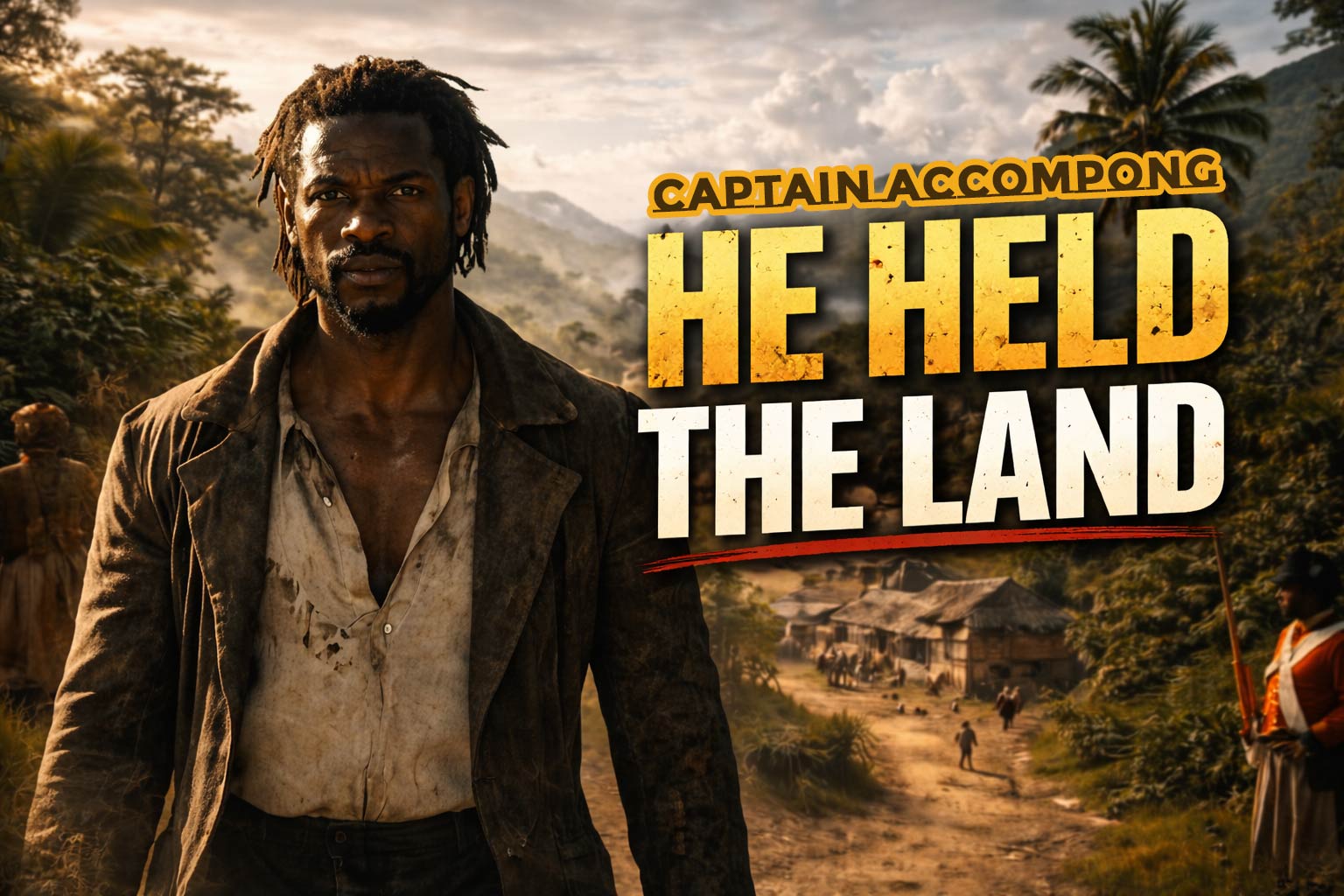
Captain Accompong is one of the most important, yet least understood figures in Jamaican history.
In the 1700s, as the British Empire tightened its grip on the island, a different power was rising in the hills of western Jamaica. The Maroons—freedom fighters, strategists, and survivors—had built a resistance the British could not break.
Among them stood Captain Accompong. He is widely recognized as the brother of Cudjoe, the leader of the Leeward Maroons, and is often linked by tradition to Nanny of the Maroons. Together, this lineage represents one of the strongest foundations of resistance in the Caribbean.
During the First Maroon War, Accompong played a critical role in a campaign that forced the British into a position they rarely accepted—negotiation. The Maroons used the Cockpit Country as a natural fortress, turning the terrain into a weapon. Ambush tactics, intelligence networks, and coded communication allowed them to outmaneuver a global empire.
In 1739, that pressure resulted in a treaty with Cudjoe. The agreement granted the Maroons land, freedom, and the right to govern themselves. But it also came with conditions—ones that tied them, in complex ways, to the colonial system they had resisted.
Within that treaty, Accompong was named as successor.
This is where his role shifts.
He was no longer only a warrior. He became the man responsible for protecting what had been won.
After Cudjoe’s death, Accompong attempted to unify Maroon leadership. But the British intervened, limiting his authority to Accompong Town. It was a strategic move—divide leadership, prevent consolidation, and maintain control.
Accompong adapted.
Historical accounts describe him dressed in European-style clothing—blue coats, gold buttons, embroidered waistcoats—yet often barefoot. It was not contradiction. It was balance. He moved between two worlds: African sovereignty and colonial diplomacy.
His leadership was not only political. It carried cultural and spiritual weight. The land, the people, and the ancestral connection were all part of what he was tasked to protect.
Today, that legacy continues in Accompong Town.
Every January 6th, Treaty Day is observed—not as a symbol of surrender, but as a marker of survival and negotiated autonomy.
Captain Accompong did not just fight for freedom.
He was entrusted to protect it.
And that responsibility has never left.