




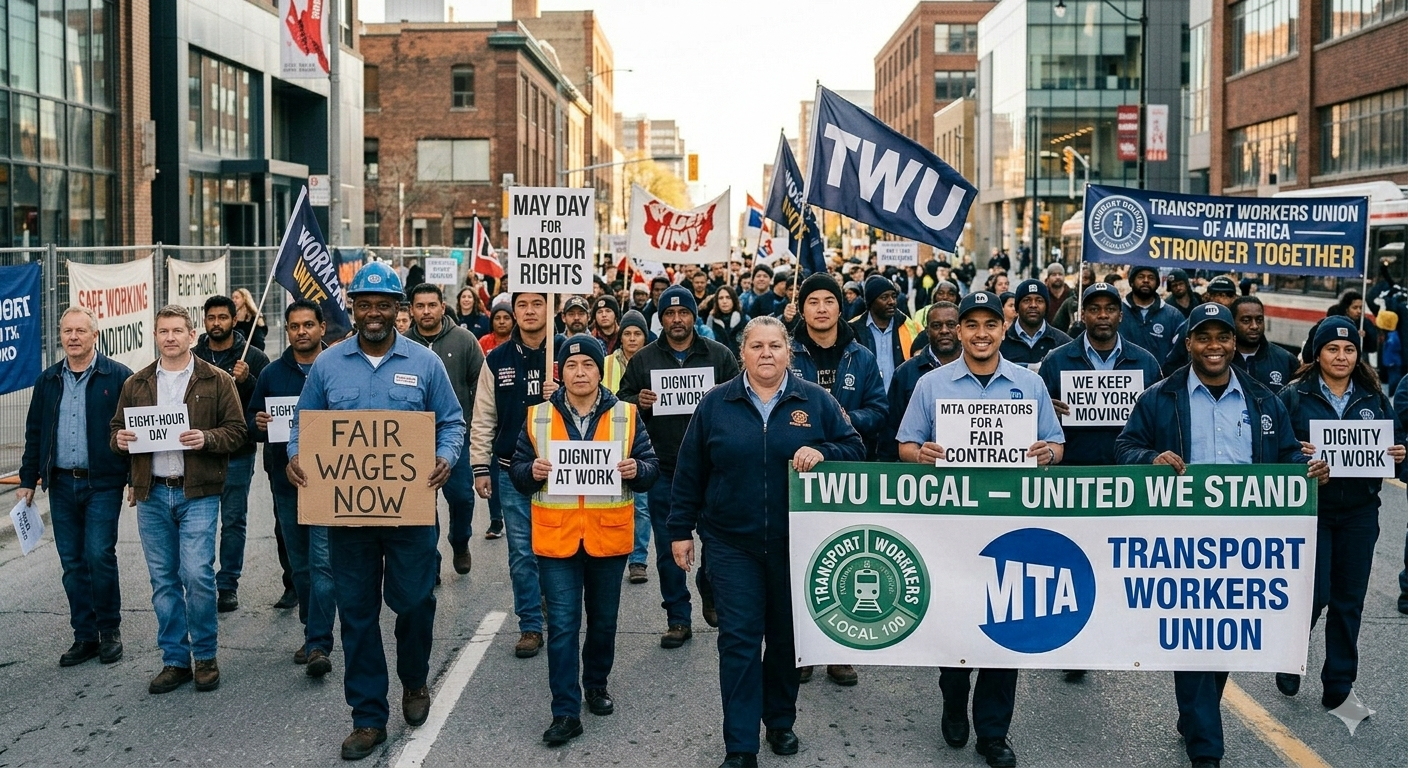
On International Workers’ Day, unions worldwide are spotlighting the enduring power of organized labor to secure fairness, safety, and respect for workers who power economies and communities.
From marches in Berlin and Johannesburg to rallies in Mumbai and Santiago(Chile), trade unions and grassroots organizations are reaffirming a core principle: collective action remains the most effective force for advancing workplace rights. In New York City, the Transport Workers Union (TWU) Local 100 is using the occasion to amplify its fight for a fair contract, demonstrating how unions continue to mobilize members and build public support amid high-stakes negotiations.
Roots in Struggle and Solidarity
May Day traces its origins to the late 19th century, when industrial workers faced grueling hours, dangerous conditions, and meager pay. In 1886, Chicago laborers organized mass protests for an eight-hour workday. The movement culminated in the Haymarket Affair, a pivotal tragedy that sparked international solidarity and transformed May 1 into a global symbol of workers’ determination.
Unions played the decisive role in turning those sacrifices into lasting gains. Through persistent advocacy and unified action, they won foundational protections — including limits on work hours, safer conditions, and the right to organize — that millions still benefit from today.
Modern Battles and Celebrations of Essential Work
Today, unions are confronting new realities: widening inequality, job insecurity, automation, digital platform work, and the impacts of climate change. Yet their message blends protest with pride. May Day events honor the nurse on extended shifts, the construction worker building infrastructure, the teacher educating the next generation, the farmer sustaining food systems, and the transit operator ensuring cities keep moving.
In New York, TWU Local 100 — representing approximately 40,000 city transit workers — is turning May Day into a powerful show of strength. Members rallied outside the Metropolitan Transportation Authority (MTA) headquarters in Lower Manhattan, voicing frustration over contract proposals they describe as inadequate and demanding respect for the essential role transit workers play.
The union highlights concerns including health care costs, overtime rules, sick leave policies, and scheduling flexibility. With the current contract set to expire at midnight on May 16, the stakes are high. Union leaders have signaled strong resolve to achieve a contract that properly values the contributions of frontline transit workers.
Potential Impact and Broader Significance
A transit work stoppage would disrupt daily life across New York’s five boroughs, affecting commuters, students, businesses, and essential services. Past strikes have shown how dependent the city is on its transit backbone — and how unions leverage that reality to press for dignity and fairness.
Beyond New York, May Day takes many forms. Some countries observe it with official holidays and ceremonies; others use it for quiet reflection or community gatherings. In the United States, where Labor Day falls in September, the spirit of May 1 still inspires union actions and calls for solidarity.
At its heart, May Day underscores the irreplaceable role of unions: bridging individual workers into a collective voice, safeguarding hard-won rights, and pushing societies to ensure that economic progress benefits everyone — not just a privileged few. As work evolves with technology and global shifts, unions remain vital in defending the principle that every job holds value and every worker deserves dignity.