




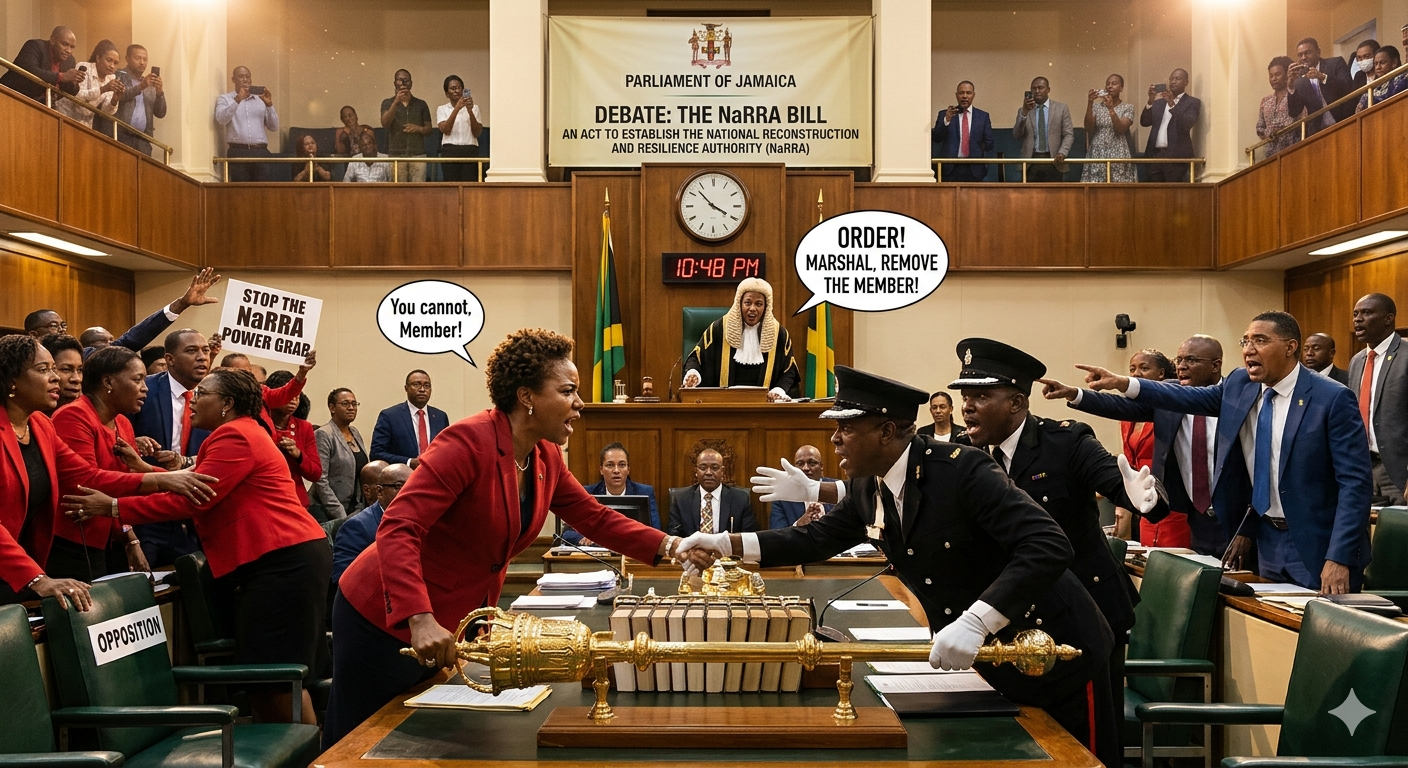
Like most Jamaicans who stayed up into the early hours of Wednesday morning watching the House of Representatives debate the National Reconstruction and Resilience Authority (NaRRA) Bill, disappointment barely begins to describe the prevailing emotion. Embarrassment is closer to the mark. What should have been a serious, focused discussion on how best to rebuild after the catastrophic devastation of Hurricane Melissa degenerated too often into partisan theatre, procedural wrangling, and outright childishness.
To give credit where it is due, MP Marlene Malahoo Forte stood out as a voice of reason in an otherwise polarised chamber. The three-term parliamentarian, former judge, and cabinet minister brought legal rigour and institutional memory to the proceedings. She rightly flagged serious gaps in the bill—insufficient provisions for accountability, transparency in procurement, independent oversight, and safeguards against the concentration of power. Her willingness to critique elements of the legislation, even as a government MP, offered a model of constructive engagement that too many of her colleagues ignored.
The majority of contributions, regrettably, followed predictable party lines. Government MPs emphasised speed and efficiency, arguing that the scale of destruction—particularly in Saint Elizabeth, Westmoreland, and other badly hit parishes—demands bold, streamlined action. Opposition members highlighted risks of ministerial overreach, potential patronage, and the absence of dedicated housing measures. These are legitimate concerns on both sides. Yet instead of genuine debate and compromise, many MPs arrived armed with prepared speeches, seemingly more interested in scoring political points than in refining a bill all agree is fundamentally necessary. The result was a marathon sitting that tested patience more than it tested ideas.
The Speaker of the House, Juliet Holness, appeared visibly agitated and combative at times, struggling to maintain decorum during the extended session. While chairing a late-night debate on such a weighty matter is never easy, the inability to enforce etiquette and order reflected poorly on the institution. In contrast, Prime Minister Andrew Holness maintained a notably calm and strategic demeanour, steering the government’s position without descending into the fray.
The low point came when the MP for South West St Andrew, Dr Angela Brown-Burke, lifted the Mace—the ceremonial symbol of parliamentary authority—in a moment widely perceived as petulant protest. What might have been intended as dramatic defiance came across on television as childish gamesmanship: taking up the marbles because one cannot have one’s way. The ensuing chaos, suspensions, and disruptions overshadowed substantive discussion and left many viewers shaking their heads at the spectacle.
Rebuilding after Melissa is not an academic exercise. Six months on, families remain displaced, infrastructure lies in ruins, and entire communities wait for tangible recovery. The NaRRA Bill, which passed the House 31-15 along party lines in the early hours of April 30, 2026, is meant to cut through red tape and deliver results. Yet the debate revealed why many Jamaicans remain sceptical: when billions in public and donor funds are at stake, speed must never become a licence for opacity or abuse.
Malahoo Forte’s measured interventions proved that thoughtful scrutiny is possible even under pressure. Parliament as a whole would do well to emulate her approach in the Senate phase rather than repeating Tuesday night’s partisan script. Jamaicans deserve better than late-night sideshows. They deserve a reconstruction process that is both urgent and trustworthy. The House must now prove, through action rather than rhetoric, that it is equal to that responsibility.