







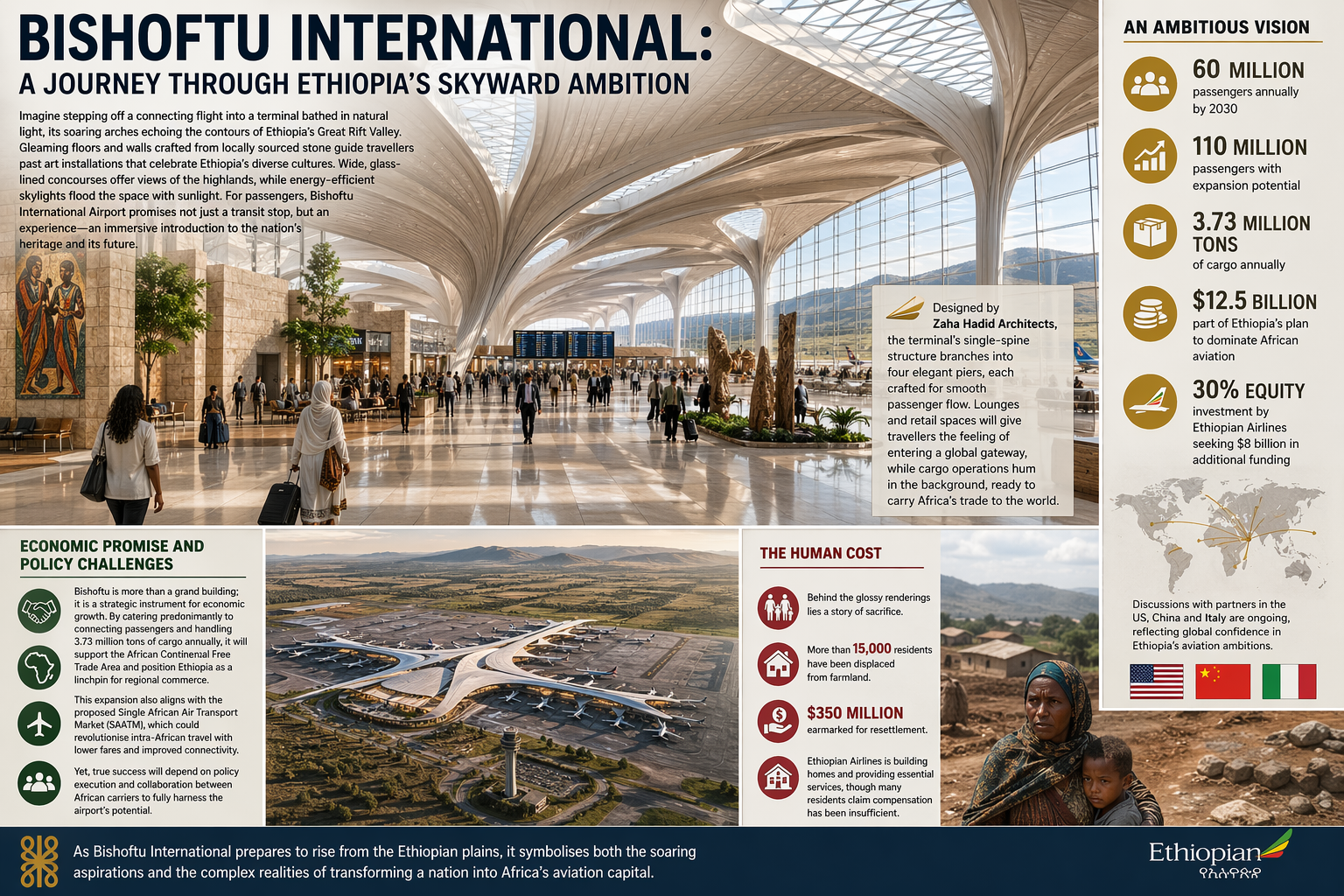
Ethiopia is taking a significant step towards establishing itself as Africa’s aviation capital with a $12.5 billion project aimed at constructing Bishoftu International Airport, located nearly 30 miles southeast of Addis Ababa. This initiative, announced by Prime Minister Abiy Ahmed Ali, is touted as the largest aviation infrastructure project in Africa, set to be operational by 2030. With the capability to handle 60 million passengers annually—and plans for future expansion to 110 million passengers—this airport could surpass Atlanta’s Hartsfield-Jackson, which recorded 106 million passengers in 2025.
Investments and Financing
Ethiopian Airlines, the continent’s largest carrier in terms of fleet size and revenue, spearheads this project and plans to invest 30% of its equity. However, an additional $8 billion is still being sought, with discussions taking place with partners in the US, China, and Italy.
Revamping African Aviation
Addis Ababa currently ranks as a top aviation hub, but the existing Bole International Airport is nearing its operational limits. Bishoftu International Airport aims to cater predominantly to connecting passengers, positioning Ethiopian Airlines as a leader in enhancing connectivity across Africa. The airport will also support the African Continental Free Trade Area, anticipating cargo handling of 3.73 million tons annually.
Design and Sustainability
The terminal, designed by Zaha Hadid Architects, is inspired by Ethiopia’s Great Rift Valley. It features a distinctive single spine design that branches into four unique piers, emphasizing sustainability with locally sourced materials and energy-efficient features. The terminal aims to integrate Ethiopia’s cultural diversity, offering travelers a glimpse of the nation’s essence.
Community Concerns
Despite the ambitious plans, the construction has sparked controversy, displacing over 15,000 residents from farmland. Ethiopian Airlines has allocated $350 million for resettlement efforts, which includes building new homes and providing essential services. Yet, reports from affected individuals indicate that many have received inadequate compensation.
Competitive Landscape
Bishoftu’s construction coincides with a broader trend of airport investments across Africa, including projects in Rwanda and Burkina Faso. Ethiopian Airlines envisions creating an air hub akin to Dubai or Doha, but recognizes the need for collaborative efforts with other airlines to improve overall connectivity.
Looking Ahead
To facilitate air travel across the continent, the Single African Air Transport Market (SAATM) has been proposed, which could dramatically increase intra-African flights and lower fares. However, achieving true connectivity will require more than just infrastructure; it hinges on effective policy execution and international cooperation, as regional competition intensifies.