





Six months after Hurricane Melissa devastated western Jamaica, the government says recovery is on track.
More than US$1.07 billion has been mobilised. Utilities are largely restored. Major roads are open. From Kingston, the message is clear: the country is stabilising.
But a closer examination of where that money is going—and where it is not—points to something more troubling: a recovery that is not just uneven, but structurally skewed.
This is not simply a story of delay. It is a question of allocation, access, and accountability.
The Headline Numbers—and the Missing Ledger
Prime Minister Andrew Holness has positioned the National Reconstruction and Resilience Authority (NaRRA) as the engine of a faster, more coordinated rebuild.
Official figures highlight:
- US$1.07 billion in financing secured
- Insurance inflows from CCRIF
- Multilateral support, including IMF disbursements
- Restoration of core utilities and transport corridors
What remains unclear is how much of that funding has been contracted, disbursed, and delivered at the community level.
To date, there is no publicly accessible, itemised breakdown showing:
- project-level spending
- contractor awards and timelines
- parish-by-parish allocation
- the share directed to small-scale agriculture or informal housing
In effect, the recovery is being reported in aggregates—but managed in opacity.
Without a public ledger, there is no way to independently verify who is benefiting, how quickly funds are moving, or where bottlenecks persist.
Procurement Without Visibility
Interviews with contractors and parish-level stakeholders suggest a procurement system that is centralised, accelerated—and difficult to scrutinise.
Three patterns recur:
- Bundled contracts large enough to exclude most local firms
- Emergency procurement rules limiting open competition
- Delayed disclosure of awarded contracts and scopes of work
Individually, these are defensible in a crisis. Taken together, they create the conditions for concentration—where a small pool of firms absorbs a disproportionate share of recovery spending.
At present, there is no consolidated, publicly searchable registry allowing citizens to track who is being paid to rebuild their communities.
That absence is not administrative. It is consequential.
Agriculture: The Missing Line Item
Nowhere is the gap more visible than in Saint Elizabeth, long considered the country’s agricultural backbone.
Farmers describe a recovery stalled by three constraints:
- No liquidity — insurance and grant flows remain slow or inaccessible
- No access — debris continues to block feeder roads
- No timeline — little clarity on when support will arrive
A UNDP estimate places storm debris at roughly 4.8 million tonnes. Clearance has prioritised primary corridors, leaving agricultural routes partially obstructed months later.
The consequence is not abstract. It is seasonal.
Missed planting cycles now threaten to cascade into prolonged income loss, reduced domestic supply, and deeper rural vulnerability.
Despite this, there is no clear public accounting of how much of the US$1.07 billion recovery envelope is specifically allocated to smallholder agriculture.
Public Health: Parallel Systems, Fragmented Data
The Ministry of Health reports progress in restoring facilities. But restored infrastructure does not guarantee accessible care.
Across affected communities, residents and frontline workers report:
- intermittent shortages of basic medicines
- increased exposure to waterborne disease
- limited outreach in remote districts
Confirmed leptospirosis deaths stand at 14. Dengue cases are rising. Yet comprehensive, regularly updated parish-level data remains difficult to access.
At the same time, food insecurity in the western belt has doubled to 13%.
These indicators are not isolated. They are linked—through sanitation, nutrition, and access. But they are tracked in silos, obscuring the full scope of post-storm vulnerability.
Displacement Without a Registry
The closure of public shelters is being presented as a milestone.
But it is, at best, a partial measure of progress.
In Westmoreland and Saint Elizabeth:
- an estimated 120,000 structures lost roofing
- thousands of families have relocated informally
- overcrowding and partial habitation remain widespread
There is no centralised, publicly available registry tracking where these households are, what conditions they face, or when they will be rehoused.
They have exited the shelter system. They have not exited displacement.
In policy terms, they are no longer counted. In reality, they remain at risk.
Speed vs. Scrutiny
NaRRA is being designed to cut through bureaucracy.
But speed without transparency introduces a different kind of risk:
- procurement without traceability
- financial reporting without distributional clarity
- visible infrastructure gains without parallel social recovery
The result is a recovery that is efficient in execution—but uneven in experience.
What Accountability Would Look Like
At this stage, the issue is not resources. It is visibility.
A credible recovery framework would include:
- a public, searchable database of all reconstruction contracts and beneficiaries
- monthly parish-level expenditure reporting
- a clearly defined allocation stream for small-scale agriculture
- a national registry of displaced households post-shelter closure
- Integrated reporting linking health, nutrition, and environmental risk
These are not structural reforms. They are baseline transparency measures.
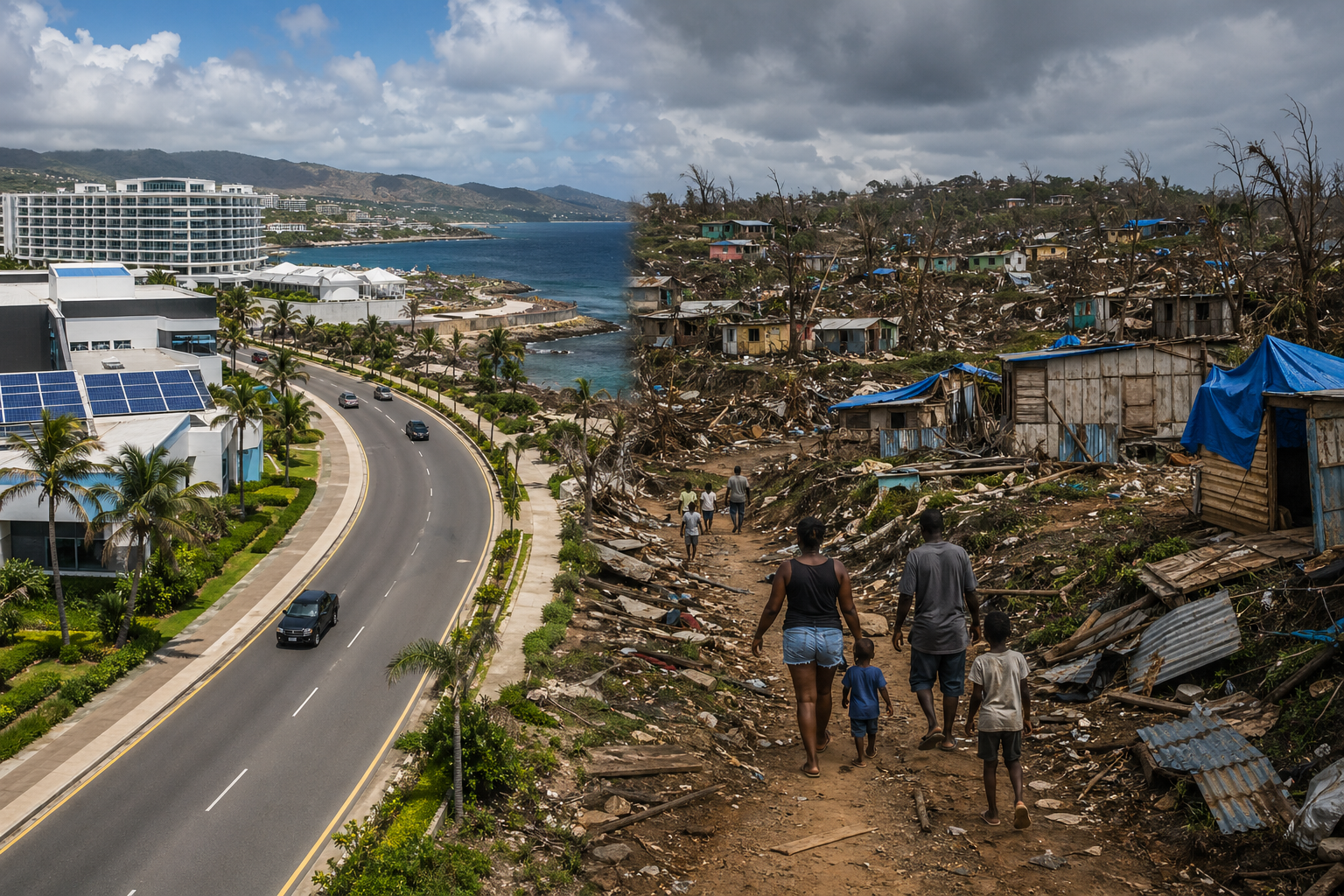
Two Jamaicas, One Paper Trail
Two realities now exist side by side in Jamaica.
One is legible: billions mobilised, infrastructure restored, recovery underway.
The other is harder to capture: farmers missing planting seasons, families living under patched roofs, clinics operating without supplies.
The divide between them is no longer just a function of time.
It is a function of traceability.
Until recovery can be tracked—contract by contract, parish by parish—the question will remain unanswered:
Not whether Jamaica is rebuilding,
but who, exactly, it is rebuilding for.