





Jamaica Supreme Court filing demands outgoing leader stop acting as Colonel and hand over community assets.
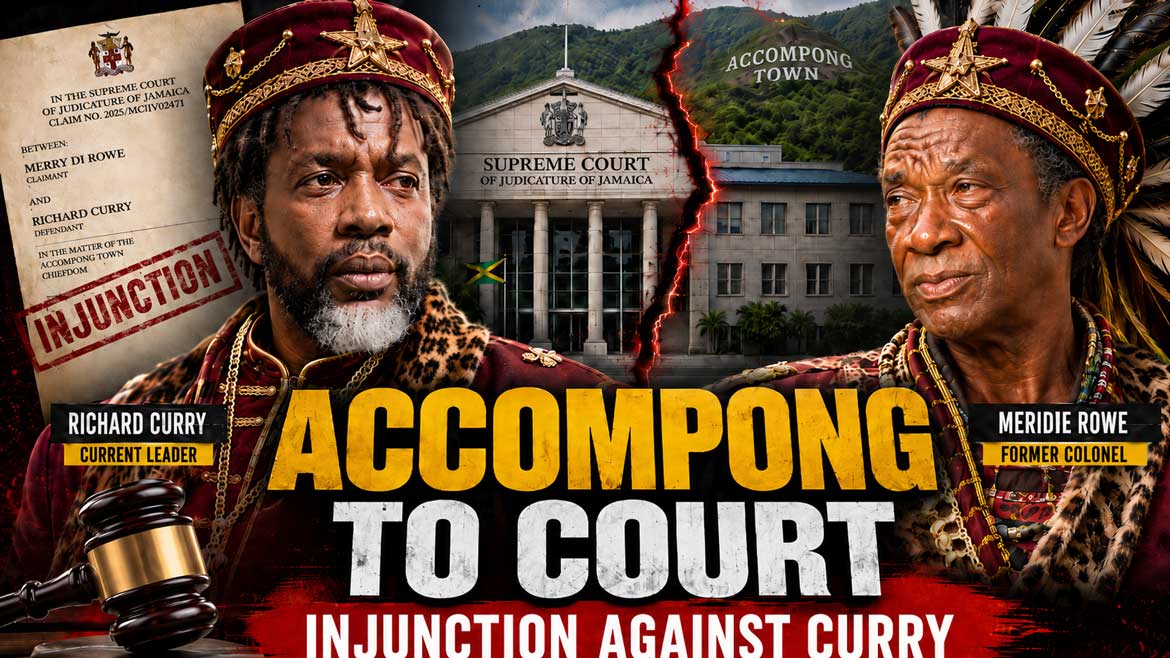
The simmering leadership crisis in one of the Caribbean’s most storied autonomous communities has escalated to Jamaica’s highest court, with former Colonel Meridie Rowe filing for an interim injunction to stop Richard Currie from continuing to govern the Accompong Town Maroon Community — nearly three months after his five-year tenure expired.
The application, stamped by the Civil Division of the Supreme Court on May 5th, 2026, asks the court to immediately prohibit Currie from acting as Colonel, selecting an Interim Council, creating an Election Council, compiling a voter list, or calling an election. Rowe also wants the court to declare all of Currie’s actions since February 18th — the date his term ended — null and void, and to order him to surrender all community assets, funds, and documents to a Justice of the Peace or the nearest police station.
It is a dramatic legal turn in a dispute that has been building for months in the hills of Saint Elizabeth, where the Accompong Maroons — descendants of West African enslaved people who won their independence from the British through guerrilla warfare and a landmark 1739 treaty — have governed themselves for nearly three centuries.
Currie swept into office in February 2021 as the youngest Colonel in modern Accompong history, defeating the long-serving incumbent, Ferron Williams, in what was described at the time as a thumping victory. A former corporate professional with stints at PricewaterhouseCoopers and several multinational firms, Currie arrived with an ambitious agenda: economic sovereignty, infrastructure development, and the defence of the Cockpit Country from bauxite mining interests. He branded his administration the “Sovereign State of Accompong” and cultivated a high public profile, drawing endorsements from dancehall artists and a feature in Forbes.
But as his term wound down, the mood shifted. By February 2026, with no election date announced and no enumeration process underway, at least five candidates — including Rowe and Williams — began pressing Currie to set a date. Currie pushed back, arguing that the devastation caused by Category 5 Hurricane Melissa in October 2025 had displaced residents and delayed the enumeration that was supposed to begin in November. He posted a video to Instagram declaring that he remained the chief until the Maroons decided otherwise at the polls.
The challengers were unconvinced. At a mass meeting in March — which Currie’s team attempted to delegitimise by calling it unauthorised — Williams and other candidates accused Currie of stalling out of fear he would lose. Another contender, Cadien Wallace, gave Currie a public ultimatum and said the candidates were prepared to invite the Electoral Office of Jamaica directly to begin planning the election, with or without him.
At the heart of Rowe’s legal challenge is a claim that Currie has not merely delayed the election, but has fundamentally corrupted the process by which it should be conducted. In his sworn affidavit, Rowe — who identifies himself as a Maroon, a member of the community, and a candidate for the Colonel position — lays out what he describes as centuries-old customs governing leadership transitions.
Under those traditions, he says, when a Colonel’s tenure expires before an election is organised, governance is supposed to transfer to an Interim Council. Each candidate has the right to nominate two representatives to sit on an Election Council, which oversees the enumeration of voters and the conduct of the vote. The Electoral Office of Jamaica, which has assisted with Accompong elections since 1982, trains the enumerators. The voters’ list is reviewed and verified by representatives of all candidates, and the election date is set by consensus.
Rowe alleges that Currie has broken with every one of these conventions. According to the affidavit, Currie failed to transfer power to an Interim Council, instead continuing to act as Colonel after February 18th. He allegedly set up an Election Council without consulting other candidates, used enumerators of his own choosing who were not trained by the Electoral Office, and conducted the enumeration process without the participation or knowledge of rival candidates. Rowe says a body created by Currie since his 2021 election — comprised of people loyal to him — has been screening candidates for eligibility, and that this body refused to accept or acknowledge Rowe’s candidacy despite written notification.
Reports from the ground have supported elements of these claims. In April, both Rowe and Williams told the Jamaica Observer that non-Maroons were being encouraged to register on the voter list, that the enumeration was being carried out by someone who was not a Maroon, and that the process was happening without the knowledge of most of the community. Williams said at the time that the challengers were preparing to seek legal intervention.
The Accompong Town Maroon Community is not just any village. It occupies a unique position in Jamaican constitutional and historical life — an autonomous territory whose governance structures predate Jamaica’s independence by more than two centuries. The community’s nine voting districts encompass Maroons spread across the island, and only verified Maroons are eligible to vote. The election of a Colonel is a matter not just of local politics, but of cultural sovereignty.
Rowe’s filing asks the court to protect that sovereignty by ensuring the election process follows established custom. His fourth prayer for relief — that the court order Currie to allow all candidates to nominate representatives to the Election Council — is essentially a request to reset the entire electoral machinery and start over on fair terms.
The affidavit was sworn on April 30th, 2026, at Mt. Salem in Montego Bay, before Justice of the Peace Kevin McLean. The claim was filed by Phillip, Traile & Company, attorneys based in Trelawny.
Currie, who as recently as March was still referring to himself on Instagram as the “Paramount Chief” of the Sovereign State of Accompong, had not publicly responded to the court filing at the time of this report. The matter is now before the Supreme Court under Claim No. SU 2026 CV.
For a community that won its freedom from the British Empire through force of arms and the strength of its unity, the question before the court is whether its own leader has now become the threat to the democratic traditions his predecessors fought to establish.
This is Accompong Network News. Like, share, and subscribe — and stay connected with Accompong News.