





Walton Morant, Tullow Oil, United Oil & Gas, and the Public Interest Question Behind Jamaica’s Offshore Licence Transfer
By Accompong Network News
Investigative Follow-Up
Thirty years of exploration brought foreign companies to Jamaica in search of oil beneath the island’s surrounding seabed. They studied the offshore blocks, mapped the ocean floor, spent money, filed reports, and promoted the possibility that Jamaica’s waters could hold commercially valuable oil.
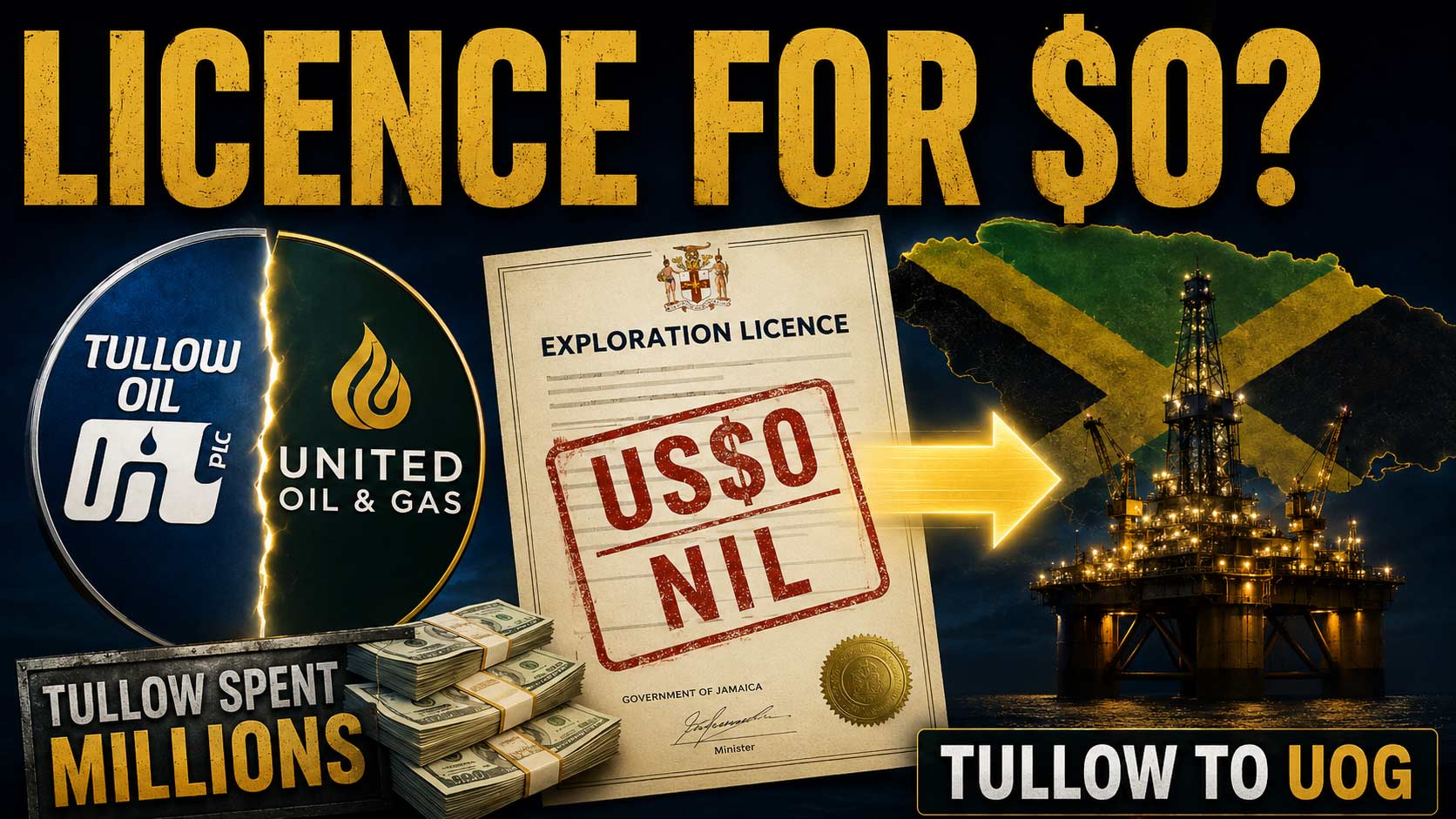
Then one of the most important offshore oil licences connected to Jamaica moved hands for zero dollars.
Not one million.
Not ten million.
Not even one dollar.
The phrase used in the corporate record was “nil consideration.”
In plain language, that means the licence interest was acquired without a purchase price.
That does not automatically mean wrongdoing. Companies transfer assets for many reasons. A company may want to exit a project. A buyer may agree to take on future costs. A seller may decide an asset no longer fits its strategy.
But this was not just any asset.
This was an offshore oil exploration licence connected to Jamaica’s natural resources.
So the public-interest question remains:
How does a licence connected to Jamaica’s offshore oil potential move through private hands for zero dollars?
This is not an allegation of illegality. It is a question of transparency.
Because the oil did not move.
The seabed did not move.
Jamaica did not move.
Only the licence moved.
And that is where the story begins.
The Walton Morant Licence
The licence at the centre of this story is the Walton Morant offshore licence, covering a large offshore area south of Jamaica.
For years, the licence formed part of Jamaica’s wider offshore oil exploration story. One of the major companies involved was Tullow Oil, a British oil and gas company with extensive experience in offshore exploration.
Tullow had been involved in Jamaica’s offshore oil search, and the Walton Morant licence was part of the effort to test whether Jamaica had commercially valuable oil beneath its waters.
By 2020, however, Tullow was moving away from Jamaica. In its public reporting, Tullow recorded a significant write-off connected to the Walton Morant licence.
The company had spent years studying the potential.
Then it walked away.
But the licence did not simply disappear.
It moved.
The Transfer to United Oil & Gas
On August 3, 2020, United Oil & Gas announced that it was acquiring Tullow’s interest in the Walton Morant licence.
The key phrase was:
“Nil consideration.”
That means United Oil & Gas acquired the interest without paying a purchase price.
In plain language:
The licence moved for zero dollars.
Again, that does not automatically mean anything improper occurred. But when a national resource licence moves for no purchase price, the public has a right to ask basic questions:
If the licence had no value, why did another company want it?
And if it did have value:
Why was the transfer price zero?
That is the heart of the issue.
Same Seabed, Different Company
The resource itself did not change.
The ocean floor did not change.
The geological possibility did not change overnight.
What changed was control of the licence.
That is why corporate filings matter.
A licence is not oil.
A licence is not a refinery.
A licence is not a guarantee of discovery.
But a licence is power.
It gives a company the right to explore.
It gives a company the right to control information.
It gives a company the right to position itself if something valuable is found.
So when a licence connected to national resources moves for zero dollars, the people deserve a clear explanation.
Not only from the companies involved, but from the government responsible for managing Jamaica’s natural-resource rights.
The public should be able to see:
- Who approved the transfer?
- What valuation was used?
- What obligations came with the licence?
- What did Jamaica receive?
- What protections were put in place?
- What happens if commercial oil is ever discovered?
These are not anti-business questions.
They are national-interest questions.
The Former Employer Connection
There is another part of this story that deserves attention.
United Oil & Gas was not a random company appearing out of nowhere. Its leadership had a prior connection to Tullow.
That does not automatically mean anything improper happened. People move between companies all the time. Former employees start new companies. Industry experience often follows people from one project to another.
But when a national resource licence moves from one company to another for nil consideration, and the receiving company has leadership with past ties to the selling company, transparency becomes even more important.
The question is not simply:
Was this illegal?
The question is:
Was Jamaica given a full and public explanation of how this deal served the national interest?
Natural resource deals are not private matters only.
They affect the people.
They affect future revenue.
They affect sovereignty.
They affect what Jamaica may or may not control if commercial oil is ever found.
The Value Question
Here is the contradiction the public needs to understand.
If the Walton Morant licence had little or no value, why did United Oil & Gas want it?
But if it had real potential value, why was it transferred for zero dollars?
That is the question.
Exploration is risky. Oil exploration is expensive. There is no guarantee that oil will be found.
But speculative does not mean meaningless.
Companies do not usually spend years chasing something they believe has no possible value. They chase potential. They chase data. They chase position. They chase future rights.
That is why Jamaica must ask harder questions.
Because when the licence moves quietly, the public may not see the real value until years later.
By then, the company holding the paper may already be in position.
Jamaica’s Public Interest
This story is not only about Tullow.
It is not only about United Oil & Gas.
It is about how Jamaica manages its own natural-resource rights.
A country can welcome foreign investment and still demand transparency.
A country can invite exploration and still protect its people.
A country can work with international companies and still ask:
What are we giving away?
What are we getting back?
Who benefits if the gamble pays off?
That is the difference between development and extraction.
Development builds national wealth.
Extraction removes value while the public receives the smallest piece.
So when Jamaica’s offshore oil licence moves for nil consideration, the public deserves more than silence.
The public deserves the full chain.
The full explanation.
The full valuation.
The full approval process.
The full terms.
The Bigger Pattern
The Walton Morant licence is only one part of a larger story.
In the mining chain, another set of licences moved too.
Six Jamaican mineral licences connected to copper and gold exploration were sold to Geophysx Jamaica for $210,000.
Those licences later became part of a much larger corporate story involving major international mining interests.
So the pattern is simple:
Jamaica’s land stays here.
Jamaica’s seabed stays here.
Jamaica’s minerals stay here.
Jamaica’s oil potential stays here.
But the licences move.
They move through foreign companies.
They move through corporate filings.
They move through quiet transactions.
They move before the public fully understands what has happened.
And by the time the country starts asking questions, the gate may already be closed.
The Question Jamaica Needs Answered
If the offshore oil licence had no value, why did another company want it?
And if it had value:
Why did it move for zero dollars?
This is not about attacking investment.
This is about defending transparency.
Natural resources are not just business assets.
They are national inheritance.
They belong to the people.
And when rights connected to those resources move through private hands, the public deserves to know who opened the gate, who walked through it, and what Jamaica received in return.
The oil did not move.
The island did not move.
The seabed did not move.
Only the licence moved.
And that is why we follow the money.
We follow the licences.
And we follow the gate.
This is Accompong Network News.