








The British Virgin Islands has activated a new system granting conditional public access to beneficial ownership information, marking a shift in how the territory balances financial transparency and privacy.
Under the newly operational Legitimate Interest Access (LIA) regime, journalists, academics, and civil society organisations can request information on who ultimately owns or controls companies registered in the territory. However, access is not automatic. Applicants must demonstrate a clear and specific link between their request and the prevention or investigation of financial crime, such as money laundering or terrorist financing.
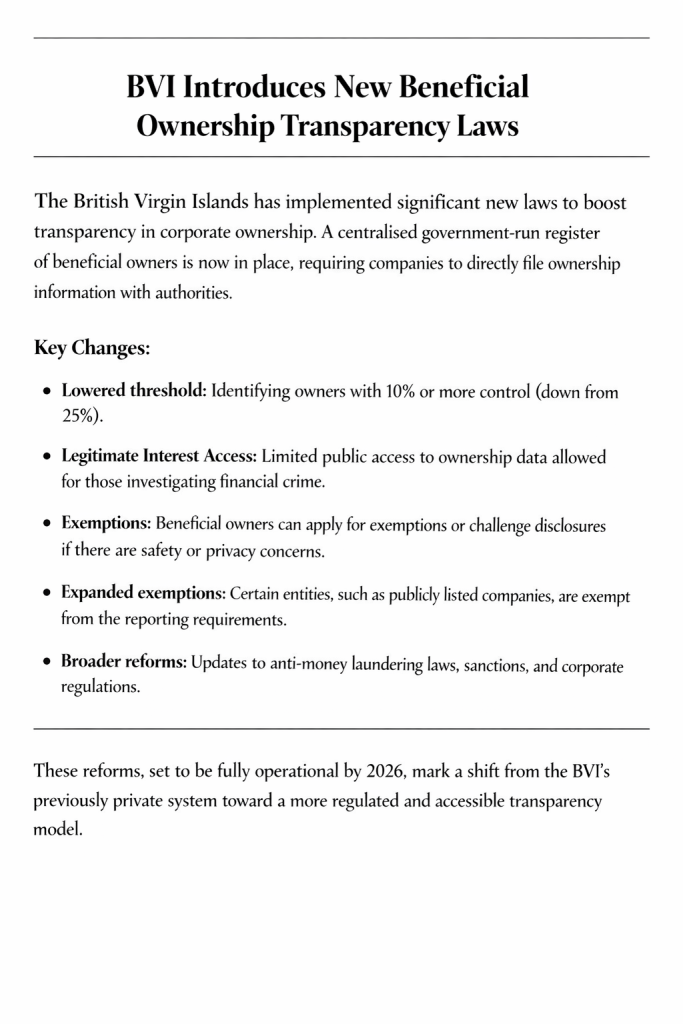
Authorities in the territory stressed that law enforcement agencies will continue to enjoy full and rapid access to ownership data through existing international information-sharing mechanisms, positioning the new system as an additional, rather than primary, transparency channel.
The move places the BVI on a different path from the United Kingdom, which has long advocated for fully public registers of beneficial ownership across its Overseas Territories. Instead, the BVI’s approach reflects a broader post-2022 European trend that restricts access based on “legitimate interest,” often citing privacy and data protection concerns.
The introduction of the LIA system is expected to have mixed implications. While it opens a pathway for non-law enforcement scrutiny, access may be slower and more limited depending on how strictly authorities interpret eligibility requirements. The government has framed the system as delivering “transparency with safeguards,” though critics argue it may still fall short of global expectations for open and verifiable corporate ownership.
The policy shift could also rekindle tensions with the UK if London reiterates its preference for fully public registers as the international benchmark.
Observers say the effectiveness of the new regime will depend on practical factors, including approval rates for requests, processing times, associated fees, and whether beneficial owners are notified or allowed to challenge disclosures. Any formal response from the UK government is also likely to shape the next phase of the debate over transparency standards in the territory.