







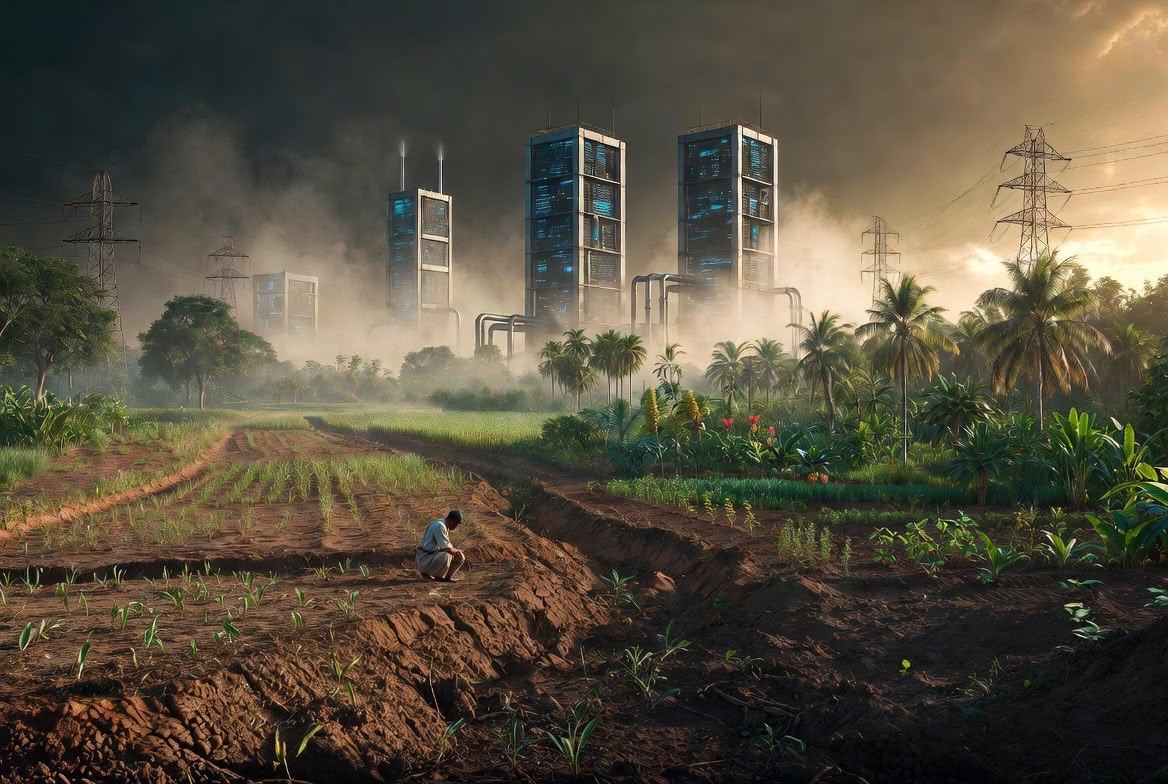
The world is fixated on the wrong emergencies.
Public debate oscillates between fears that genetically modified crops will poison us and promises that artificial intelligence will solve everything from disease to education to climate change. Billions of dollars flow into AI startups, while governments argue over biotechnology regulations and digital competitiveness.
Meanwhile, the foundations of human survival are deteriorating in plain sight.
Hundreds of millions of people remain hungry. Billions lack reliable access to nutritious food. Soils are degrading, freshwater systems are under stress, biodiversity is collapsing, and the ecological processes that make agriculture possible are being steadily weakened.
Food security and environmental protection are not niche policy concerns. They are the primary conditions for civilisation itself. Until those foundations are secured, GMOs and AI remain secondary technologies — useful tools, perhaps, but not the central priority.
The Scale of the Actual Crisis
In 2025, an estimated 645 million people faced chronic hunger. That figure alone should arrest us — but the deeper number is this: roughly 2.1 billion people, more than a quarter of humanity, experienced moderate or severe food insecurity. Acute food crises gripped hundreds of millions more, with confirmed famine conditions in parts of Gaza and Sudan and severe risks in several other regions.
Global hunger has declined modestly for three consecutive years, and that modest progress matters. But it conceals a more dangerous trend beneath it. Africa now contains the largest number of hungry people in the world. Healthy diets remain unaffordable for vast populations. And the natural systems that make food production possible are being quietly dismantled.
Consider one projection: approximately 40 percent of the world’s land is already degraded. If current trends continue, that figure could approach 90 percent by mid-century. That is not a typo. It is a trajectory — one that receives a fraction of the political attention devoted to the latest AI model release or biotechnology regulatory dispute.
Agriculture accounts for the majority of global freshwater withdrawals, a significant share of greenhouse-gas emissions, and one of the leading drivers of deforestation and biodiversity loss. More than 1.6 billion hectares of land are degraded, with over 60 percent of that degradation occurring on agricultural lands themselves. Pollinator declines, wetland loss, declining soil fertility, and disrupted water cycles directly reduce our capacity to grow food. Climate change intensifies every one of these pressures through heat, drought, erratic rainfall, floods, and expanding pest and disease ranges.
These statistics are not merely humanitarian indicators. They reveal failures in production systems, distribution networks, governance, conflict prevention, and — most fundamentally — the degradation of the natural resource base on which all food production ultimately depends.
Protect the Productive Base First
The world does not primarily suffer from a shortage of theoretical farmland. It suffers from the progressive destruction of the productive capacity of the land already in use.
Unsustainable farming practices have degraded vast areas of cropland and pasture, reducing yields, increasing vulnerability to climate shocks, and creating deepening dependence on chemical and energy inputs. The greatest opportunity lies not in discovering new land but in closing yield gaps on existing farmland, regenerating degraded soils, improving water management, and rebuilding biodiversity within agricultural landscapes.
Practices such as reduced tillage, diversified crop rotations, agroforestry, better nutrient cycling, and restoration of soil organic matter increase resilience against drought, floods, and market shocks. Protecting remaining forests, wetlands, and grasslands is equally essential — these ecosystems regulate water, store carbon, support pollinators, and buffer agriculture against climatic extremes.
When soils erode, aquifers decline, and biodiversity collapses, the entire food system becomes more fragile. That fragility does not care how advanced our seeds, sensors, or algorithms have become.
What Tropical Islands Can Teach Us
Tropical and subtropical regions — including many island societies — demonstrate that resilience often comes from diversification rather than monoculture.
Without harsh winters, these regions can sustain year-round production of calorie-rich staples and nutrient-dense fruits. Polycultures and agroforestry systems combining cassava, sweet potato, breadfruit, perennial vegetables, coconut, avocado, and underutilised fruits such as rambutan, mangosteen, longan, dragon fruit, and passion fruit can improve dietary diversity, reduce dependence on imported temperate staples, and generate local income. These are not exotic curiosities. They are working systems — ones designed around ecological reality rather than maximum short-term efficiency.
These systems are not universal solutions. Islands still face water scarcity, shallow soils, invasive species, hurricanes, and sea-level threats. But they carry an important lesson for agricultural thinking at every scale: resilience grows when production is designed around what the land and climate can sustain, not what the market momentarily rewards.
Why Technological Debates Miss the Point
This is where GMOs and AI must be considered together — not because they are equivalent technologies, but because they represent the same category of error in our collective priorities.
Genetically modified crops have produced measurable benefits in many contexts. Studies show average yield gains of roughly 22 percent, significant reductions in insecticide use for insect-resistant varieties, higher farmer profits — especially in developing countries — and support for reduced-tillage systems that lower erosion and emissions. Those are real contributions, and dismissing them reflects ideological reflex rather than honest assessment.
But GMOs cannot replace healthy soils, reliable water supplies, functioning ecosystems, effective markets, or political stability. They are a tool. A sophisticated tool with a legitimate role — but a tool nonetheless, one that cannot substitute for the foundation on which all agriculture depends.
Artificial intelligence presents the same structural problem, only more acutely. AI can genuinely improve precision agriculture, weather forecasting, pest detection, irrigation management, and supply-chain coordination. When applied directly to ecological monitoring — satellite-based deforestation detection, soil carbon measurement, water-use optimisation — it may even contribute to securing the very foundations this essay argues for. That distinction matters, and it deserves acknowledgement.
But the current trajectory of AI investment is overwhelmingly focused on general-purpose computational systems whose resource intensity and corporate concentration have little connection to the immediate needs of food security. Data centres increasingly compete for electricity, water, and land — the same resources agriculture requires. Forecasts suggest that AI’s future energy and water demands could rival the consumption of entire large populations. And critically, the capital flowing into AI is not idle capital that would otherwise fund watershed restoration. Much of it reflects a reordering of institutional attention — of what governments, development agencies, and research bodies treat as urgent — and that reordering has consequences.
The danger, in both cases, is not the technology itself. It is allowing these debates — the biotechnology culture war, the AI investment frenzy — to consume the political bandwidth and intellectual energy that should be directed at the degradation of soils, watersheds, and the ecological systems that make any agriculture possible. GMOs ask us to argue about seeds. AI asks us to marvel at computation. Both conversations, however important in their own domains, become a distraction when they crowd out the question of whether the land beneath the seeds will still be productive in fifty years.
The Smallholder at the Centre
Any honest discussion of food security must place smallholder farmers at its centre — not as beneficiaries of distant policy, but as the primary agents of the solution.
Smallholders manage an estimated 80 percent of the world’s farmland in developing countries and produce a substantial share of the food consumed in the regions most vulnerable to hunger. They are simultaneously the most food-insecure population on earth and the people with the deepest practical knowledge of local soils, microclimates, and ecological rhythms. They are also chronically underserved by both the biotechnology debate and the AI investment wave — neither of which is primarily designed with a subsistence farmer in Malawi or a smallholder rice grower in Bangladesh in mind.
Supporting smallholder resilience — through access to diverse seed varieties, improved soil management, secure land tenure, functioning local markets, and climate adaptation resources — is not a charitable gesture. It is a structural investment in the foundations of global food security.
A More Rational Hierarchy
Human survival rests on functioning ecosystems and reliable access to food.
That means protecting and restoring soils, water cycles, biodiversity, and climate stability must come first. Closing yield gaps on existing farmland, regenerating degraded lands, supporting smallholders, and encouraging climate-adapted diversified farming systems should rank far above both the GMO culture war and the AI investment frenzy.
Technology has an important role within that hierarchy. Improved crop varieties — whether conventional, gene-edited, or transgenic — can help. Digital tools and artificial intelligence, when directed toward ecological monitoring and smallholder empowerment rather than abstract computation, can improve forecasting, logistics, and farm management. The question is not whether to use these tools. The question is whether we are governing them as tools — means toward an end — or treating them as ends in themselves.
A civilisation that pours extraordinary resources into increasingly resource-hungry computational systems while its soils erode, its aquifers decline, and hundreds of millions remain hungry is not demonstrating technological maturity. It is neglecting the ecological foundations of its own existence.
The rational priority is straightforward: secure the living systems that feed humanity first. Everything else follows from that.