




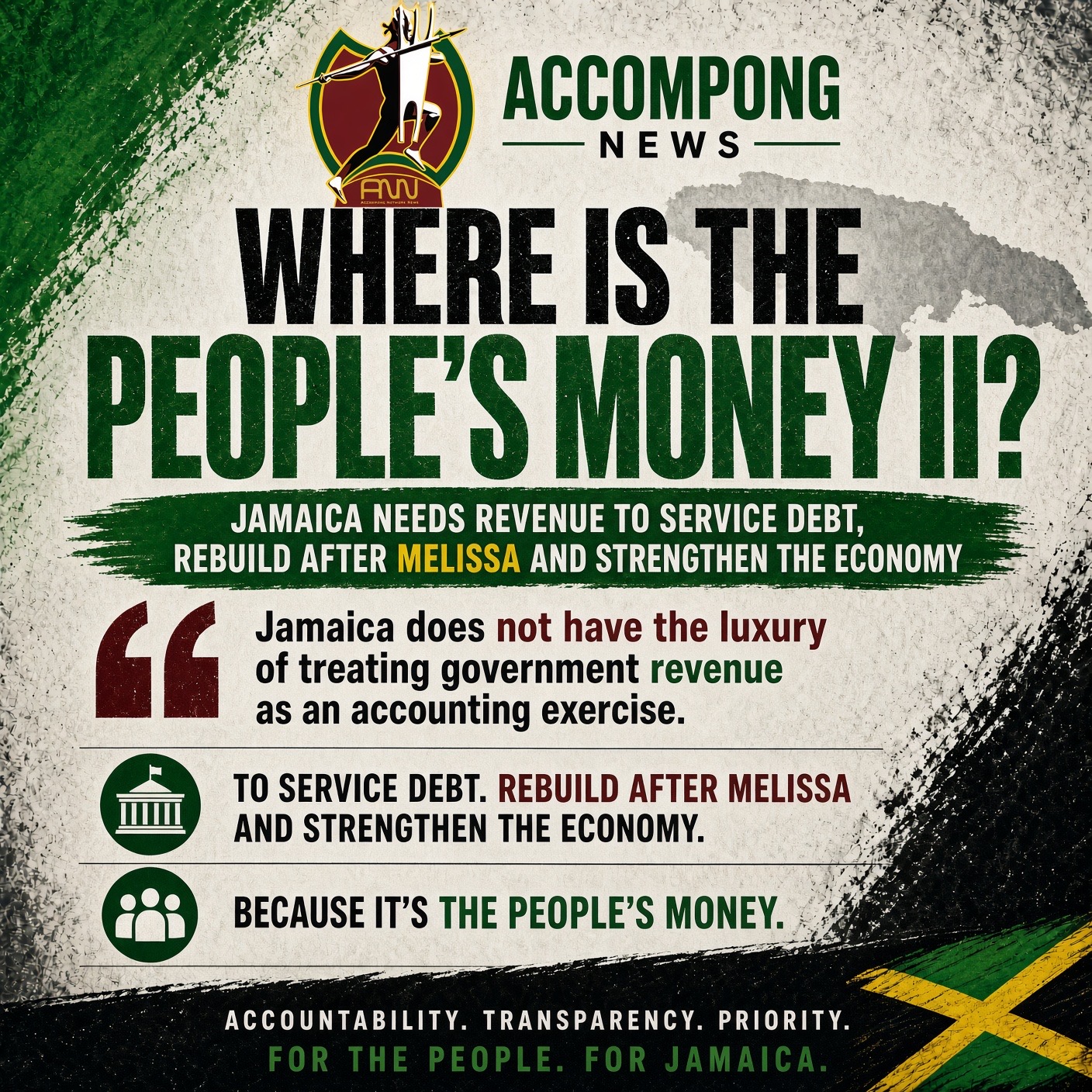
Jamaica needs revenue to service debt, rebuild after Melissa and strengthen the economy
Jamaica does not have the luxury of treating government revenue as an accounting exercise.
The country needs money to repair infrastructure, maintain public services, support economic activity and meet its debt obligations.
That makes the delayed Environmental Protection Levy more than a dispute over a tax measure.
It is a test of the Government’s ability to collect the revenue it has already built into its fiscal plans.
The revised levy was projected to generate approximately $3.6 billion during the 2026/27 financial year. It was originally expected to take effect earlier in the year but will now become payable from October 1.
The Government’s Ministry of Finance has overall responsibility for developing the fiscal framework and collecting and allocating public revenue. Its fiscal programme identifies stronger revenue collection as important to financing national priorities, including reconstruction and capital investment following Hurricane Melissa.
That responsibility has become more significant because of the scale of the hurricane’s economic impact.
The Planning Institute of Jamaica has estimated Melissa’s total losses and damage at approximately $1.952 trillion, equivalent to 56.7 per cent of Jamaica’s 2024 GDP. Prime Minister Andrew Holness has subsequently described the impact as approximately 57 per cent of GDP.
Jamaica must now undertake major reconstruction while maintaining essential services and continuing to service its debt.
That makes every legitimate dollar of government revenue more important.
The Environmental Protection Levy applies to imported and locally manufactured goods. The revised rate is 0.85 per cent, with locally manufactured goods assessed on 75 per cent of their selling price and imports assessed on their full CIF value.
The levy reaches into the import and manufacturing chains that supply Jamaican businesses and consumers. Once the State establishes a levy covering those activities, it has a responsibility to ensure that the legal and administrative machinery required to collect it is ready when the budget says the money should begin flowing.
That is where the delay becomes difficult to dismiss as a technical matter.
The Government had announced the measure months earlier, yet Tax Administration Jamaica confirmed in May that the higher rate could not be enforced because the necessary legislation had not been completed.
By September, another problem emerged. Debate in the Senate had to be suspended after the version of the Environmental Protection Levy Bill initially circulated was found not to have the required certification as a money bill. The incorrect version was withdrawn and replaced.
These are failures in the administrative machinery through which the State collects revenue.
The financial consequence is disputed.
A straight-line calculation by Senator Ramon Small-Ferguson puts approximately $1.6 billion of the $3.6-billion projection at risk because of the delay. That is an estimate, not a confirmed loss.
The Government has cited a much lower estimate of approximately $646 million from the independent fiscal commissioner.
Whatever the final figure, the public needs a transparent accounting of what was expected, what was actually collected and what remains recoverable.
That matters because Jamaica’s revenue position is already under pressure. For the April-to-June quarter, tax and grant receipts were reported to be $28.7 billion below budget.
A delayed revenue measure therefore has consequences beyond the levy itself. If expected revenue does not arrive, the Government has fewer resources available for public programmes and reconstruction. The alternatives are spending adjustments, additional borrowing or other revenue measures.
For a country dealing with damage equivalent to more than half of its annual economic output, those choices carry significant fiscal consequences.
Jamaica must also protect the progress it has made in managing public debt. Government policy has emphasized financing recurrent expenditure from current revenue rather than relying excessively on borrowing. The Ministry of Finance has warned about the dangers of returning to a debt cycle in which borrowing is used to finance ordinary government spending and interest obligations.
The Government is also preparing to apply General Consumption Tax to certain imported digital services. That measure will require systems to identify overseas providers, register taxpayers, process payments and enforce compliance across borders.
The environmental levy therefore raises a broader question about administrative capacity.
The issue is not whether Jamaicans should contribute through taxation. It is whether the State is capable of collecting efficiently, legally and on time the revenue it has already determined is necessary.
A Government’s fiscal credibility depends not only on the accuracy of its forecasts, but also on its ability to execute them.
If $3.6 billion is incorporated into the revenue plan, the collection system must be ready to capture that revenue. If implementation is delayed, the Government must account for the resulting gap and explain how it will be addressed.
Jamaica needs reliable revenue to meet its obligations, protect public services and finance the work ahead.
The public should therefore expect more than revenue announcements.
It should expect revenue collected on time, efficiently and transparently.
That is the central issue exposed by the environmental levy delay: whether the machinery of the Jamaican State can turn its revenue projections into money available to serve the country.