




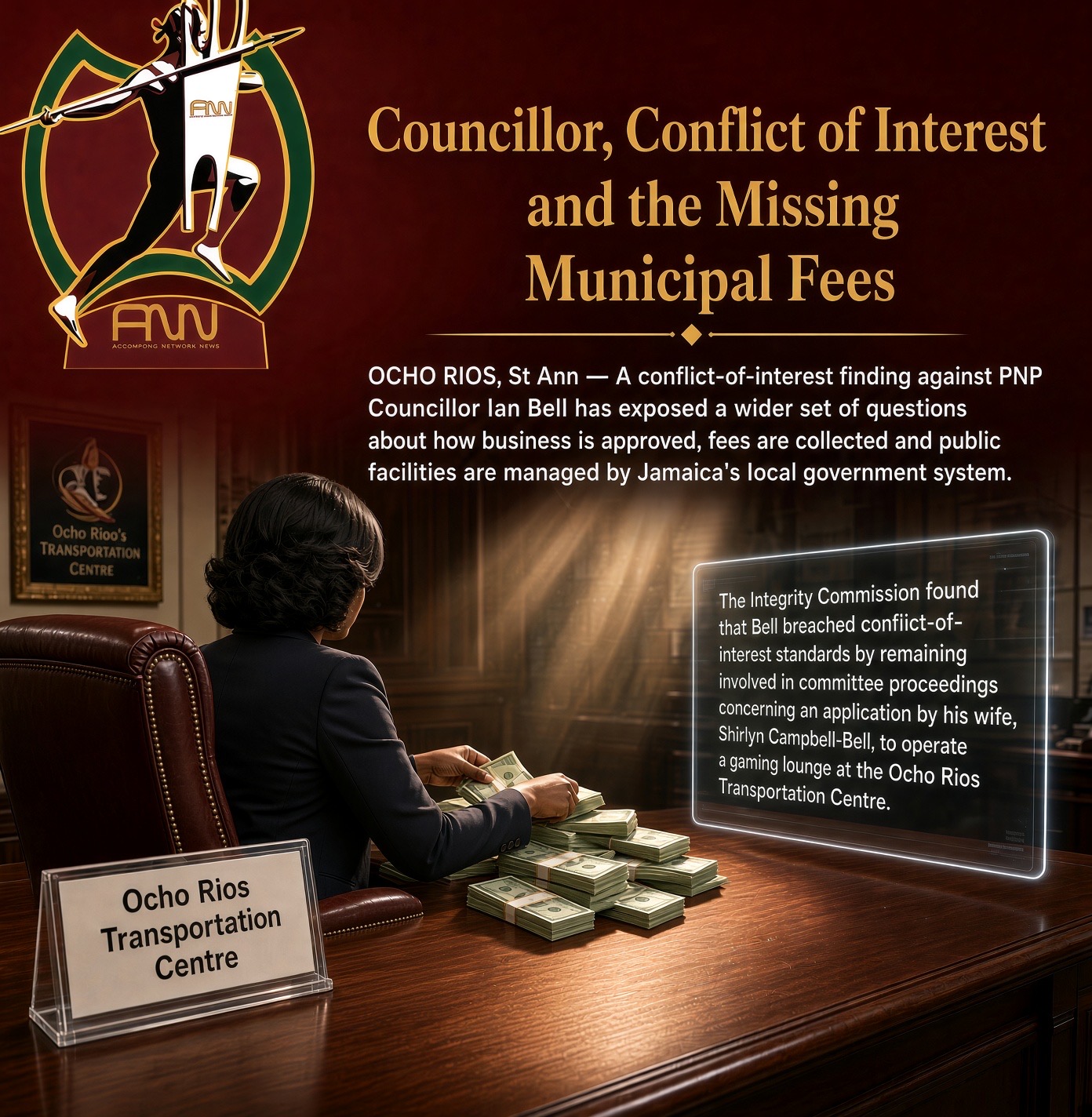
OCHO RIOS, St Ann — A conflict-of-interest finding against PNP Councillor Ian Bell has exposed a wider set of questions about how business is approved, fees are collected and public facilities are managed by Jamaica’s local government system.
The Integrity Commission found that Bell breached conflict-of-interest standards by remaining involved in committee proceedings concerning an application by his wife, Shirlyn Campbell-Bell, to operate a gaming lounge at the Ocho Rios Transportation Centre.
But the controversy does not end with the councillor’s failure to recuse himself.
The investigation also uncovered a business operating from a 40-foot container without a building permit and, according to the report, without paying fees to the St Ann Municipal Corporation since 2023.
That raises a straightforward public accountability question: who was responsible for ensuring that money owed to the municipal corporation was collected?
Campbell-Bell’s application was itself handled outside the corporation’s ordinary process, according to the Integrity Commission.
The application did not use her married surname and was personally delivered by Councillor Bell. Instead of going through the corporation’s registry, it appeared as a supplemental item before the Commercial Services Committee.
The Director of Investigation described the omission of the married name as misleading and potentially deceptive.
Bell maintained that he had disclosed his relationship with the applicant to the committee. However, the investigation concluded that disclosure did not relieve him of the responsibility to recuse himself.
That distinction is critical.
The issue was not simply whether other committee members knew the applicant was Bell’s wife. The Integrity Commission found that Bell himself had a duty to remove himself from deliberations involving a direct family interest.
The municipal corporation also came under scrutiny.
The Integrity Commission found that an approval letter was issued prematurely and that the required approval from the Minister responsible for local government had not been obtained.
The result was a chain of questions involving both elected representation and administrative oversight.
A councillor participated in a matter involving his wife. An application was brought forward as a supplemental item after being personally delivered by that councillor. A structure was operating without a building permit. The business reportedly operated for years without paying municipal fees. And an approval letter was issued before all required approvals were secured.
Taken together, those findings point to more than an isolated procedural error.
They expose weaknesses in the controls designed to protect public resources and prevent personal interests from becoming entangled with government decision-making.
The Integrity Commission has recommended that Bell be formally reprimanded and subjected to a disciplinary review. It has also called for all outstanding fees to be recovered.
That recovery is now an important part of the accountability process.
Every dollar owed to a municipal corporation represents revenue that can support public services and the operation and maintenance of public facilities. The longer those fees go uncollected, the greater the question of administrative responsibility becomes.
The investigation also recommends a broader legal response.
The Director of Investigation has urged the government to consider criminalizing the failure of public officials to disclose conflicts of interest.
That recommendation would move the issue beyond disciplinary consequences and into the realm of potential criminal liability.
The PNP has accepted the Integrity Commission’s findings and supports its recommendations.
The party noted Bell’s history of dedicated public service but acknowledged that his record does not excuse the breach. It agreed that he should have recused himself.
That response is significant because the issue is not fundamentally about party politics.
It is about whether public officials can be trusted to separate their public responsibilities from private interests and whether government institutions have the systems necessary to detect and correct violations when they occur.
The Ocho Rios Transportation Centre is a public facility. The fees associated with businesses operating there are public revenue. The approval process is governed by public rules.
Those rules are supposed to apply regardless of who is seeking permission to operate a business.
The Integrity Commission’s findings now leave several matters requiring follow-through: the recovery of outstanding fees, the disciplinary review of Bell, the circumstances surrounding the premature approval, and the adequacy of the municipal corporation’s controls over permits, applications and revenue collection.
The larger issue is therefore not simply what did Councillor Bell do?
It is whether the systems responsible for protecting the public interest worked at all.
And if they did not, who will be held accountable for the money that should have been collected, the approvals that should not have been issued prematurely, and the procedures that were bypassed?