






By Jah B
Central bank appointments are rarely read in isolation. Investors, multilateral institutions, rating agencies and regional partners interpret them as signals about the policy environment likely to follow. The appointment of Dr. R. Brian Langrin as Governor of the Bank of Jamaica signals something specific: not a departure from Jamaica’s economic trajectory, but a deliberate intention to consolidate it.
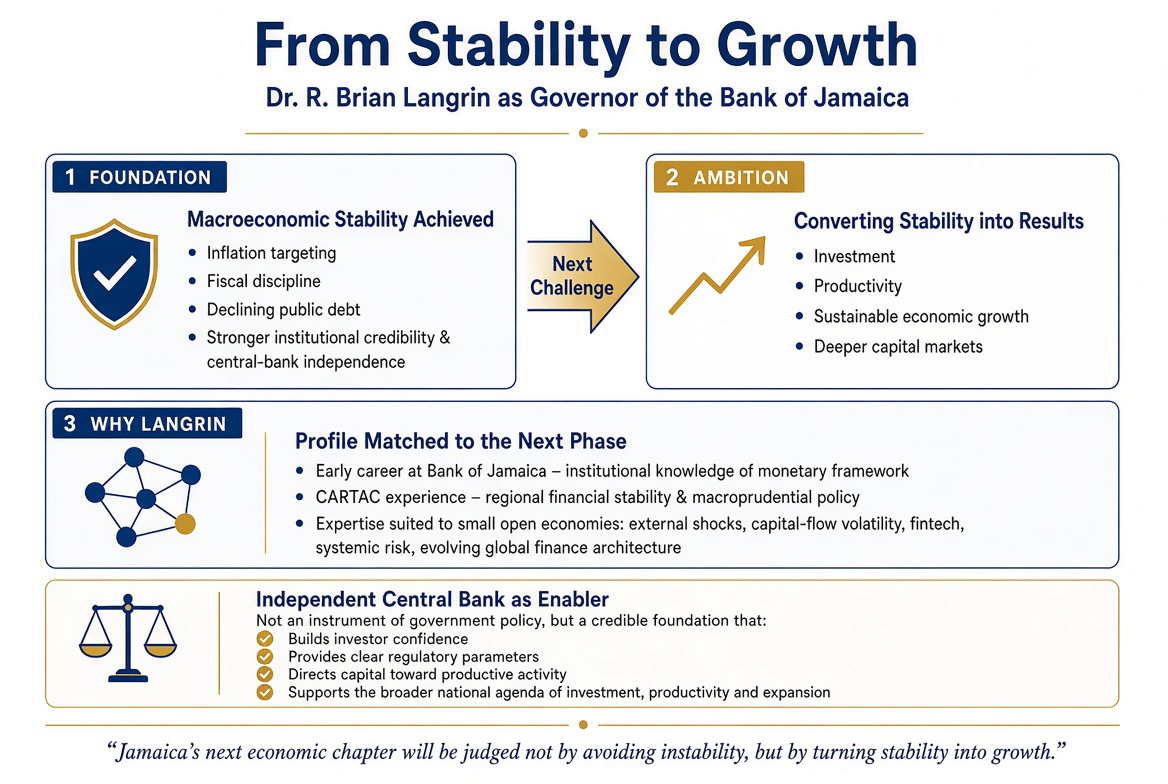
The foundation he inherits matters. For more than a decade, Jamaica rebuilt institutional credibility from a position of considerable vulnerability — public debt once approaching 150 per cent of GDP — through fiscal consolidation, sustained primary surpluses, inflation targeting and stronger central-bank independence. That transformation changed Jamaica’s standing internationally, moving the country from chronic participant in IMF adjustment programmes to an economy capable of demonstrating sustained policy discipline.
Langrin inherits that credibility, and the expectation that he will strengthen it.
His professional background is directly relevant. His years at the Bank of Jamaica gave him intimate knowledge of the institution, its policy framework and the particular challenges of managing monetary policy in a small, open economy exposed to external shocks. His subsequent work with the Caribbean Regional Technical Assistance Centre (CARTAC) extended that experience regionally and placed him within the multilateral technical networks that are increasingly central to Jamaica’s economic strategy.
That multilateral experience may prove especially valuable. Jamaica’s relationship with international financial institutions has evolved significantly — the country now engages the IMF not as a borrower seeking emergency balance-of-payments assistance, but as a policy partner accessing instruments such as the Precautionary Liquidity Line and the Resilience and Sustainability Facility. Sustaining that standing requires officials capable of engaging international institutions with technical authority. Langrin enters the Governorship fluent in those networks and in the language global financial institutions operate in.
His background in macroeconomic policy, financial stability and macroprudential frameworks also positions him well for the broader responsibilities of the role — financial system modernisation, capital-market development and supporting productive investment while protecting institutional credibility.
Context reinforces the signal. Nigel Clarke’s appointment as IMF Deputy Managing Director in 2024 placed a Jamaican with substantial policymaking experience at a senior level within the international financial system. A Bank of Jamaica Governor with complementary technical and multilateral depth strengthens Jamaica’s institutional reach considerably.
Yet the appointment does not come without risk. Small open economies remain exposed to external shocks — commodity price volatility, shifting global financial conditions, climate-related disruptions — that can rapidly test even well-anchored frameworks. Central-bank independence, hard-won over the past decade, requires constant institutional vigilance. Langrin will need to navigate those pressures while maintaining the policy credibility his appointment is itself intended to reinforce.
The confidence generated by his appointment will be quieter than dramatic, and more consequential for that. It is the confidence of investors and institutions that Jamaica remains committed to policy credibility, institutional continuity and constructive multilateral engagement — built not on a single appointment, but on a decade of demonstrated discipline that this appointment is designed to extend.