






By Jah B | Accompong News | August 12, 2026
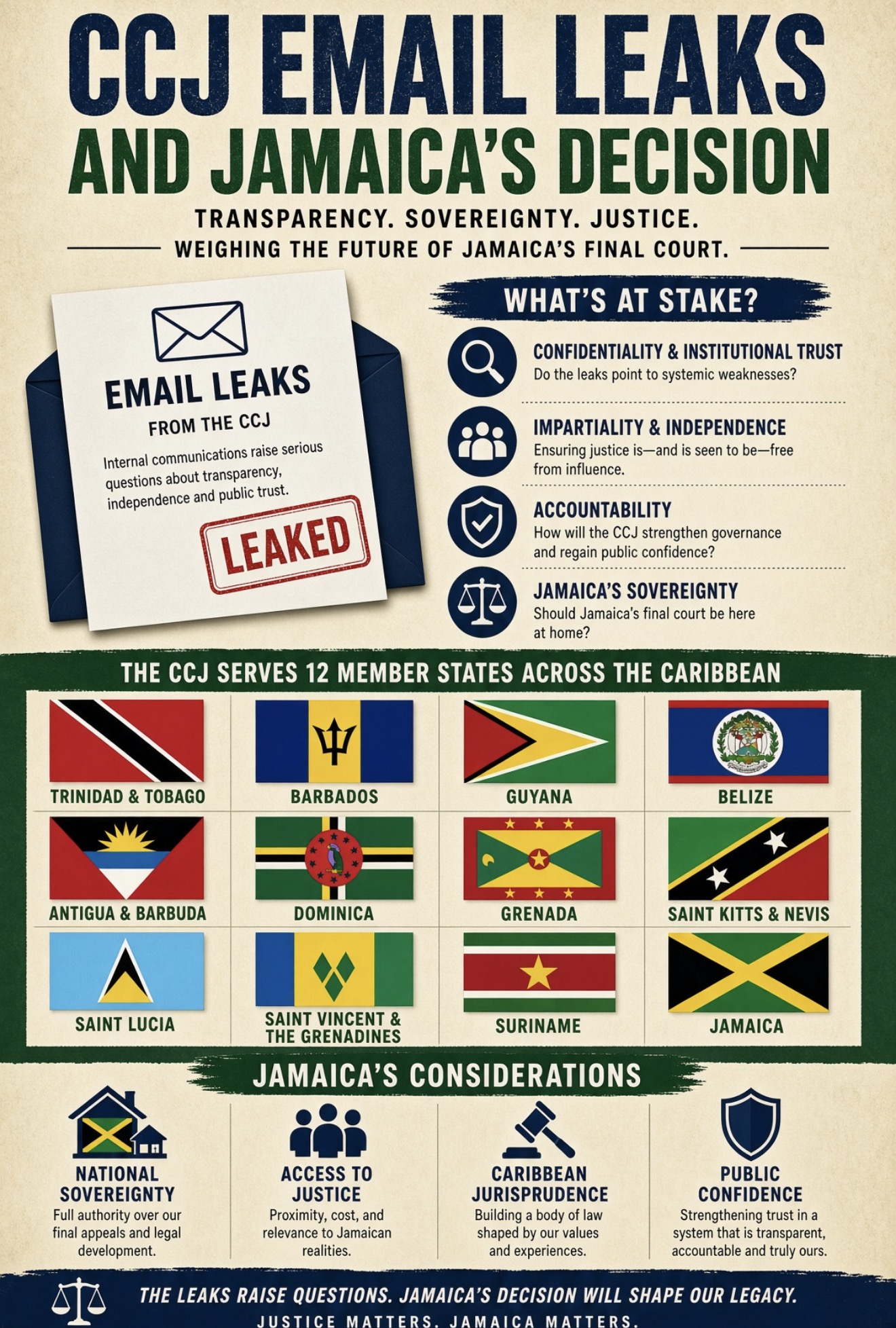
KINGSTON, Jamaica — A controversy surrounding leaked correspondence involving judges of the Caribbean Court of Justice (CCJ) has reopened one of Jamaica’s longest-running constitutional debates: whether the regional court should replace the Judicial Committee of the Privy Council as the country’s final appellate court.
The controversy has produced sharply different reactions among Jamaica’s political and legal establishment.
Senate President Tom Tavares-Finson, KC, has warned that it would be “extremely reckless” for Jamaica to proceed with making the CCJ its final court while serious allegations about the court’s internal governance remain unresolved.
Opposition Leader and PNP President Mark Golding, meanwhile, says the leaked correspondence has not changed his party’s support for the CCJ.
Veteran attorney Bert Samuels has also strongly defended the regional court, while former Attorney General A.J. Nicholson has maintained his longstanding position that Jamaica should move away from the Privy Council.
The dispute has now moved beyond the traditional question of whether Jamaica should have a Caribbean final court. It has become a question of whether the CCJ’s governance arrangements can withstand serious scrutiny and whether Jamaica should proceed with constitutional reform before those concerns are independently examined.
Serious allegations, but no established findings
Reports based on leaked internal correspondence describe significant disagreements among CCJ judges concerning the leadership of President Justice Winston Anderson.
Among the reported concerns are allegations about the administration of the court, the treatment of judges, judicial independence and, most seriously, the composition of judicial panels and possible attempts to influence the outcome of cases.
The allegations have not been independently established.
That distinction is critical.
There has been no judicial finding that the CCJ manipulated panels, predetermined cases or compromised the independence of its judges. The leaked material should therefore be treated as evidence of allegations and internal disagreement, rather than proof of misconduct.
However, allegations concerning the composition of judicial panels are sufficiently serious to warrant scrutiny.
The composition of a judicial panel is not a trivial administrative matter. If judges were deliberately selected or excluded for the purpose of influencing the outcome of a case, it could raise fundamental questions about judicial independence and the integrity of the court’s process.
Tavares-Finson calls for scrutiny
Tavares-Finson has emerged as the most prominent Jamaican political voice linking the controversy directly to the question of whether Jamaica should adopt the CCJ as its final appellate court.
He has argued that Jamaica should not make such a fundamental constitutional change while allegations concerning the court’s internal operations remain unresolved.
His position is not necessarily that the CCJ should permanently be rejected. Rather, he has called for the allegations to be properly examined before Jamaica proceeds.
The Senate President has particularly highlighted the reported allegations concerning judicial-panel selection, arguing that, if substantiated, they would raise serious questions about the independence and integrity of the court.
His intervention has put pressure on supporters of the CCJ to explain how Jamaica can proceed with constitutional reform while such questions remain unanswered.
Golding says PNP support remains
Golding has taken the opposite position.
The PNP president has said the leaked correspondence has not changed his party’s support for replacing the Privy Council with the CCJ.
For the PNP, the issue forms part of a broader programme of constitutional reform and Jamaica’s transition to a republic.
The party has also stressed the issue of access to justice, arguing that the cost and geographical distance associated with appeals to the Privy Council can place the final level of justice beyond the practical reach of many Jamaicans.
That argument has been echoed by Samuels, one of the strongest Jamaican defenders of the CCJ since the controversy emerged.
Samuels defends the regional court
Samuels has rejected the suggestion that the leaked correspondence demonstrates that the CCJ is incapable of delivering impartial justice.
He argues that internal disagreements among judges do not automatically establish that the court’s judgments have been compromised.
Samuels has also warned against allowing the controversy to undermine the broader project of Caribbean judicial integration.
His position rests on a distinction that is central to the current debate: a governance dispute is not necessarily evidence that the institution’s judicial decisions are invalid or compromised.
Courts are made up of individuals who can disagree over administration, leadership and legal interpretation.
The more important question is whether those disagreements have affected the impartial adjudication of cases.
That question remains unresolved.
Nicholson maintains longstanding support
Former Attorney General and Justice Minister A.J. Nicholson remains a prominent advocate of replacing the Privy Council with the CCJ.
Nicholson’s position is rooted in the argument that an independent Jamaica should ultimately have a final court within its own region rather than rely on a court based in Britain.
Supporters of the CCJ also argue that a Caribbean final court provides greater regional ownership and potentially greater accessibility for litigants.
That argument predates the current controversy by many years.
The CCJ was established as part of a wider Caribbean effort to strengthen regional integration and provide a Caribbean-based final appellate institution.
The current controversy therefore does not begin the debate over the CCJ. It has reopened it.
Malahoo Forte raises concerns about confidence
Former Attorney General and Constitutional Reform Committee co-chair Marlene Malahoo Forte has also expressed concern about the leaked correspondence and its effect on public confidence.
She has described the disclosure as a “poor display of judgement” and questioned the implications for people observing the court from outside.
However, her comments should not be interpreted as a call to retain the Privy Council.
There is presently insufficient evidence to classify Malahoo Forte as opposing the CCJ itself. Her concern appears focused primarily on the leak, the internal dispute and the potential damage to public confidence.
That distinction is important in an increasingly polarised debate.
Champagnie raises the wider constitutional question
King’s Counsel Peter Champagnie has also entered the discussion, providing a more critical perspective on the CCJ controversy.
His intervention raises a question that is frequently missing from Jamaica’s constitutional debate.
The choice does not necessarily have to be limited to the CCJ or the Privy Council.
A Jamaican final appellate court is another possible constitutional model.
Whether Jamaica has the financial, institutional and constitutional capacity to establish and maintain such a court would require a separate examination.
But the leaked correspondence has created an opportunity to revisit the broader question of what kind of final court Jamaica wants as an independent state.
Regional judicial authorities call for independent review
The controversy has also generated an institutional response.
The Regional Judicial and Legal Services Commission has acknowledged the seriousness of the allegations concerning the administration of the CCJ and judicial independence and has said that the concerns should be addressed through established mechanisms and a transparent and independent review. (newssourcegy.com)
The Commission’s response is significant.
It does not establish that the allegations are true. Nor does it constitute a finding that the CCJ’s judgments have been compromised.
But it does indicate that the controversy is serious enough to require an institutional response.
There is also a potential governance complication: Justice Winston Anderson, whose leadership is central to the allegations, is chairman of the RJLSC. That makes the independence and credibility of any review especially important. (newssourcegy.com)
Should Jamaica pause the transition?
The central question now facing Jamaica is whether the controversy should delay constitutional reform.
There is a compelling argument for a temporary pause in the final constitutional step, not because the CCJ has been shown to be unfit, but because allegations concerning judicial independence deserve to be resolved before the court assumes an even greater constitutional role in Jamaica.
That process should begin with verification of the leaked correspondence and an examination of its context.
The allegations concerning judicial-panel composition should then be investigated.
If improper panel selection occurred, investigators should determine whether any cases or judgments were affected.
The review should also examine whether the CCJ’s governance structure provides adequate safeguards when judges raise concerns about the conduct of their president or other senior judicial officials.
Most importantly, the process must be sufficiently independent and transparent to command public confidence.
The Privy Council is not automatically the answer
At the same time, the controversy should not create the impression that the alternative to the CCJ is an institution without its own limitations.
The Privy Council is a foreign final appellate court serving Jamaica.
The CCJ is a Caribbean institution created partly to provide the region with greater judicial independence.
The debate therefore involves more than institutional reputation.
It concerns access to justice, sovereignty, judicial independence and public confidence.
The fact that questions have arisen concerning the CCJ does not automatically establish that the Privy Council is the better option.
Likewise, Jamaica’s desire for judicial sovereignty should not prevent legitimate scrutiny of the institution it may ultimately choose.
A constitutional decision requires evidence
The leaked correspondence has therefore changed the terms of Jamaica’s debate.
The question is no longer simply whether Jamaica should replace the Privy Council with the CCJ.
It is also whether the CCJ’s governance arrangements meet the standards Jamaicans should expect from their highest court.
Three conclusions can reasonably be drawn at this stage.
First, the allegations are serious enough to warrant independent examination.
Second, the available information does not establish that the CCJ is institutionally compromised or that its judgments have been manipulated.
Third, the controversy does not by itself establish that Jamaica should retain the Privy Council.
For Jamaica, the prudent course may therefore be neither to abandon the CCJ nor to proceed as though the controversy does not exist.
Instead, the country could pause the final constitutional transition, demand an independent examination of the allegations, and then make the decision on the basis of verified evidence.
That would avoid turning a serious judicial controversy into a partisan political contest.
It would also send an important message about the principle at the heart of the debate:
No court seeking to become Jamaica’s highest court should be beyond scrutiny.
The CCJ should not be rejected simply because it is Caribbean.
But neither should it be protected from examination simply because it represents Caribbean judicial sovereignty.
For Jamaica, the ultimate question should be straightforward:
Which final court can provide the strongest guarantees of independence, impartiality, accessibility, accountability and public confidence?
The answer should be determined by evidence—not political loyalty, historical sentiment or the circumstances surrounding one leaked correspondence.
Accompong News will continue to follow the controversy as the CCJ, regional judicial authorities and Jamaican political leaders respond to the allegations.