






By Jah B
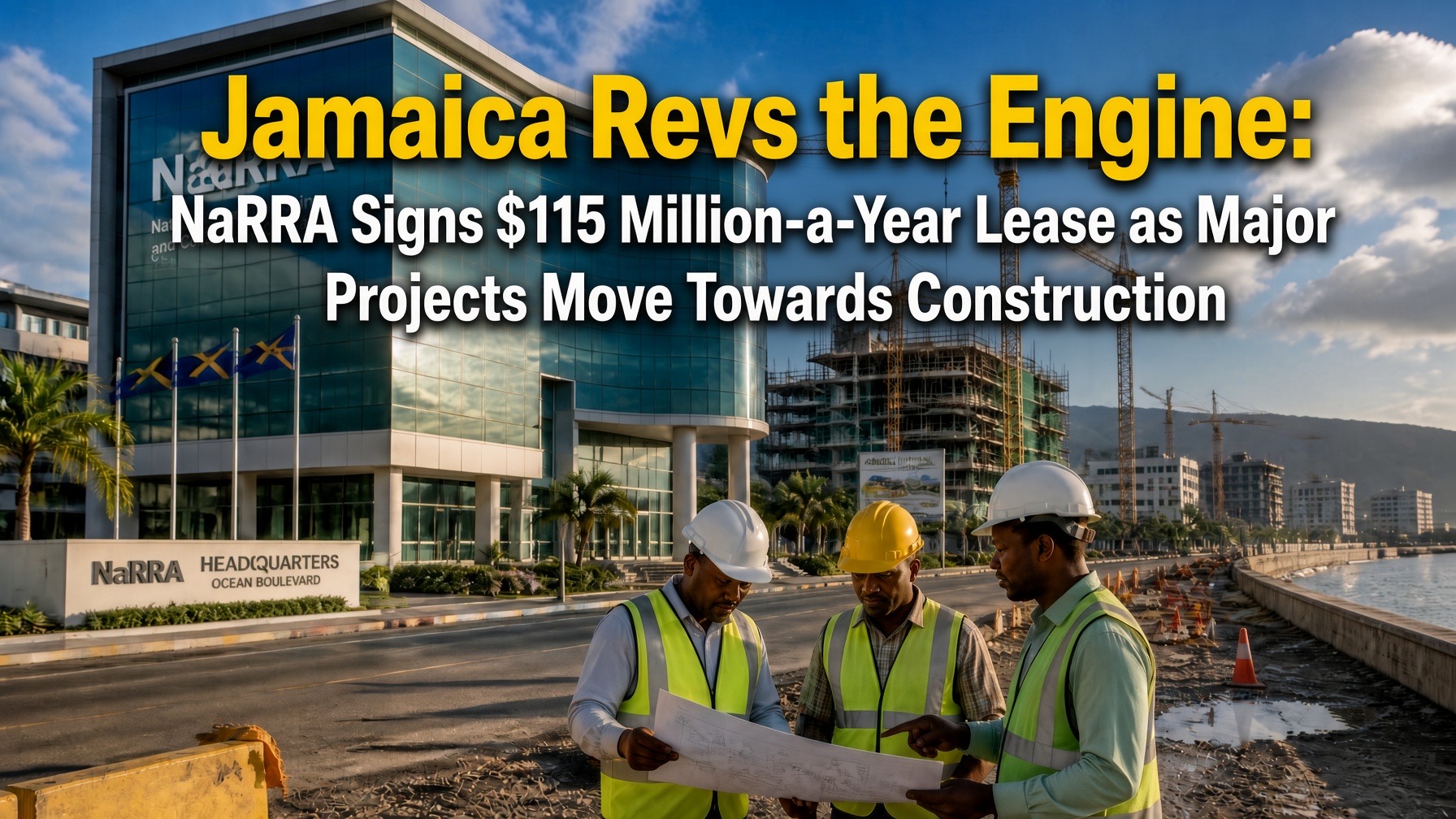
KINGSTON, Jamaica — Jamaica is putting the machinery in place for a major wave of post-Hurricane Melissa development, with the National Reconstruction and Resilience Authority (NaRRA) signing a five-year lease for a new downtown Kingston headquarters at an annual cost of approximately US$725,972, or J$115.2 million.
The authority will occupy space at the Digicel Building at 14 Ocean Boulevard, with operations scheduled to begin on 1 November. The lease rate is US$26 per square foot.
NaRRA said the property was selected following a valuation by the National Land Agency, which compared the proposed cost with current market values and rates paid by other government agencies. The authority said the assessment found the expenditure consistent with prevailing market conditions.
The building itself was designed to withstand multiple environmental hazards and incorporates structural and engineering features intended to maintain critical operations during emergencies.
NaRRA Chief Executive Officer Ambassador Antony Anderson said seismic resilience, reliable communications and backup systems were important considerations in selecting the facility.
But the office represents only a small part of a much larger undertaking.
The Scale of What Was Lost
Hurricane Melissa made landfall in western Jamaica on 28 October 2025 as a Category 5 storm — the most powerful hurricane ever recorded on the island. At least 45 people died. The initial rapid damage assessment by the World Bank and the Inter-American Development Bank placed losses at US$8.8 billion, equivalent to approximately 41 per cent of Jamaica’s 2024 gross domestic product.
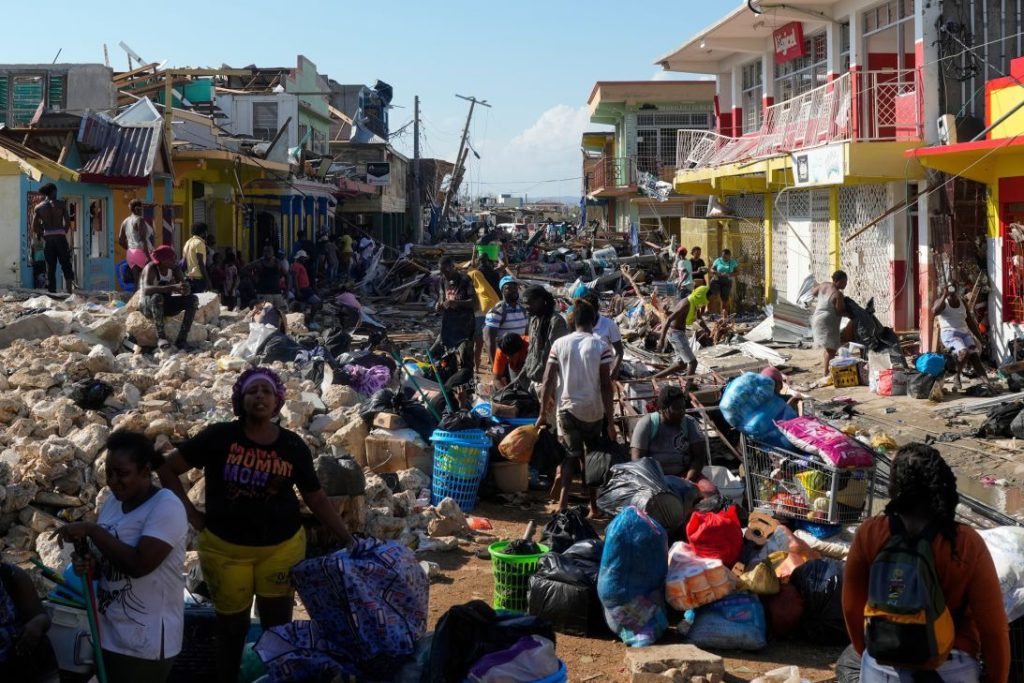
That figure has since been revised upward. Prime Minister Dr Andrew Holness, presenting to the House of Representatives during the 2026 budget debate, indicated that total loss and damage from Melissa is now estimated in excess of US$12 billion — a figure that incorporates not only direct physical destruction but indirect economic losses, fiscal costs, and the long-term disruption to livelihoods, industries and public services. For a country of Jamaica’s size, that burden is historically without precedent.
The scale of the damage is precisely what gives NaRRA its mandate — and its urgency.
The Financing Architecture
The Government has access to a three-year international development-financing package of up to US$6.7 billion following Hurricane Melissa. The package combines sovereign financing, private-sector investment mobilisation, grants and technical support. It is not US$6.7 billion in government cash sitting in one account.
Prime Minister Andrew Holness has said the financing was assembled through the IMF, World Bank Group, Inter-American Development Bank, CAF and Caribbean Development Bank. The sovereign financing component alone amounts to US$3.6 billion, with up to US$1 billion each from the World Bank, IDB and CAF, US$415 million from the IMF under its Rapid Financing Instrument large natural disaster window, and US$200 million from the Caribbean Development Bank. A further US$2.4 billion in private capital mobilisation is being pursued through IDB Invest, the International Finance Corporation and the Multilateral Investment Guarantee Agency. The bulk of the inflows will be channelled through NaRRA.
The significance of NaRRA is therefore its role as the mechanism intended to move major investments from financing and planning into execution.
The Institutional Architecture
The authority was established specifically to address delays created by fragmented government processes. Under the Government’s model, NaRRA is expected to provide a central point for project development, coordination, procurement and implementation whilst maintaining oversight and public reporting.
That model draws on a hard lesson from post-disaster reconstruction elsewhere in the region. In Dominica following Hurricane Maria in 2017, and in Puerto Rico following Irma and Maria the same year, the absence of a centralised delivery mechanism — combined with procurement bottlenecks and capacity deficits — significantly delayed the translation of financing into completed infrastructure. Jamaica has chosen to confront that risk directly by creating NaRRA before the bulk of financing flows, rather than after it stalls.
The Government is also strengthening NaRRA’s technical capacity. A US$5 million grant from the European Union through the World Bank is supporting planning, engineering, project management, costing, procurement and contract-management capabilities.
That support is important because the billions identified for Jamaica cannot automatically become roads, bridges, schools or hospitals. Projects still have to be properly designed, costed, procured and built. Whether the US$5 million in technical assistance is sufficient to underpin a pipeline of this scale is a question the Government has not yet answered publicly, and one that NaRRA’s early project delivery record will begin to answer within the next 12 to 18 months.
The Ground-Level Test
For communities such as Black River in St Elizabeth, the difference will be measured in what happens on the ground. Nearly a year after Melissa, residents in some of Jamaica’s hardest-hit western communities are still waiting for damaged infrastructure, public facilities and essential services to be restored. That timeline — the distance between a financing announcement and a functioning road or rebuilt school — is the real accountability metric.
The Government has identified roads, bridges, drainage systems, schools and health facilities amongst the areas requiring major investment. Black River and Falmouth have also been identified for transformation into more climate-ready urban centres, a designation that carries both opportunity and complexity: climate-resilient urban redesign requires community engagement, resettlement planning and long-term maintenance commitments that extend well beyond the construction phase.
NaRRA is already being positioned to handle major national projects. In March, Holness announced that the authority would lead construction of a new Kingston Public Hospital, with Cabinet approving acquisition of land for the facility. No construction timeline or procurement milestone for the hospital has been publicly confirmed — and that absence of specificity is itself a meaningful data point in assessing the authority’s early momentum.
The Accountability Question
The authority’s responsibilities extend beyond repairing damage caused by Melissa. The Government is attempting to create a central delivery system capable of handling large infrastructure investments whilst reducing some of the delays associated with conventional public-sector procedures.
That ambition comes with a significant public accountability question.
The J$115.2 million annual headquarters lease is a substantial recurring expenditure at a time when communities affected by Melissa are still waiting for damaged infrastructure and public facilities to be restored. NaRRA has justified the expenditure through the National Land Agency valuation and the building’s resilience and business-continuity features. That justification is reasonable on its face, but it will carry greater weight once the authority begins demonstrating commensurate output.
The public expectation is straightforward: NaRRA must demonstrate that its new capacity is producing measurable results. That means projects moving from plans and financing to contracts, construction and completion. It means transparent public reporting on project milestones, procurement timelines and disbursement rates — the kind of granular accountability that has been absent from previous large-scale public-sector programmes in Jamaica.
It also means that the Government should establish and publish clear performance benchmarks for NaRRA: how many projects are expected to reach procurement stage by mid-2026, how many contracts are expected to be awarded by year-end, and what proportion of the US$6.7 billion financing package is expected to be committed to active construction within the three-year window. Without those benchmarks, accountability becomes reactive rather than structural.
Holness has described NaRRA as a central mechanism for executing infrastructure at scale and speed, with the authority expected to serve as a centre of technical excellence and national coordination. For communities such as Black River, success will mean functioning roads, improved drainage, restored public facilities and infrastructure capable of withstanding future disasters.
NaRRA now has its legal mandate, leadership, headquarters and additional technical support. Against losses that now exceed US$12 billion — a figure that touches every Jamaican household in some measure — the machinery must now prove its purpose.
The engine is assembled. The next measure is performance: how quickly does it turn financing and investment commitments into work on the ground, and who will be accountable when it does not?