



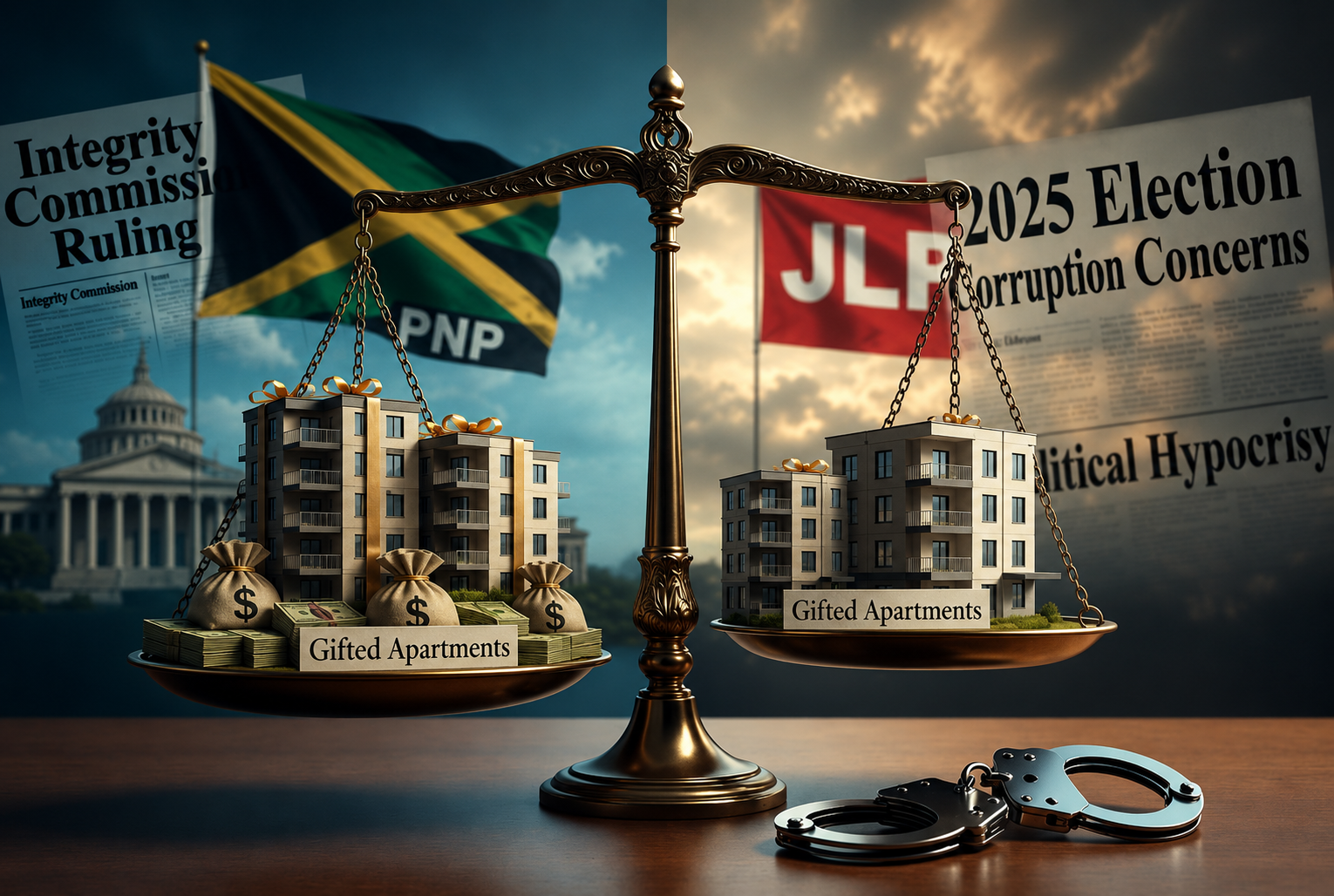
The Integrity Commission’s determination that Cabinet Minister Andrew Wheatley should face charges including illicit enrichment has renewed scrutiny of political accountability in Jamaica and reopened debate about how integrity issues are handled across party lines.
The ruling, tabled in Parliament on June 17, 2026, follows an investigation into Wheatley’s financial affairs and statutory declarations between 2013 and 2022. According to the Commission, investigators concluded that Wheatley acquired or controlled assets disproportionate to his lawful income by approximately J$164 million during that period.
The report states that Wheatley’s known income totaled roughly J$187 million, while asset-related expenditures amounted to approximately J$351 million. Based on those findings, the Director of Corruption Prosecution recommended four charges: making false statements in statutory declarations under both the Parliamentary (Integrity of Members) Act and the Integrity Commission Act, failing without reasonable cause to provide requested information, and illicit enrichment under the Corruption Prevention Act.
Investigators also identified alleged omissions involving loans, investments, and certain properties. Separate matters concerning tax compliance related to Wheatley’s former medical practice were referred to the relevant tax authorities.
One aspect of the investigation involved six apartments that Wheatley had declared as gifts. The Commission included those properties in its broader assessment of unexplained wealth.
Wheatley has strongly rejected the findings, describing them as “patently false, inaccurate and grossly misleading.” He argues that investigators failed to properly account for approximately J$168 million in rental income generated through his real estate business and did not adequately consider legitimate sources used to repay approximately J$50 million in business loans.
Regarding the six apartments, Wheatley maintains that they arose from a joint-venture real estate development. According to his account, an original 50-50 ownership arrangement was later adjusted to a 70-30 split after he was unable to satisfy certain obligations. He says the transfer was documented by attorneys as a gift and represented a legitimate commercial transaction. Wheatley further contends that he cooperated fully with investigators and possesses documentation demonstrating that his assets were lawfully acquired.
His attorney has also questioned the Commission’s conclusions, arguing that important documentation and commercial context were not sufficiently considered during the investigation.
The matter now moves to the Director of Public Prosecutions, who will determine whether charges should proceed. Wheatley has indicated that he intends to vigorously contest the allegations in court. As with any legal proceeding, the presumption of innocence applies unless and until guilt is established.
Election-Year Context
Questions surrounding integrity and corruption featured prominently during Jamaica’s 2025 general election campaign.
The governing Jamaica Labour Party, led by Andrew Holness, campaigned on economic management, tax relief, and development initiatives. Meanwhile, the opposition People’s National Party placed government accountability and transparency at the center of its campaign message.
Opposition representatives repeatedly cited ongoing Integrity Commission investigations involving government figures, including Wheatley, as evidence that stronger oversight and enforcement mechanisms were needed. The governing party responded by emphasizing due process and warning against treating investigations as proof of wrongdoing before the courts had spoken.
Wheatley entered the election cycle carrying significant political baggage. In 2018, he relinquished the energy portfolio amid controversy surrounding Petrojam. In 2020, an Integrity Commission report described aspects of his conduct as dishonest and recommended prosecution. A subsequent challenge to that report was unsuccessful in the courts. Despite those developments, Wheatley was appointed to Cabinet following the 2025 election.
The latest ruling has therefore intensified questions about how political leaders address integrity concerns before elections and how those concerns are managed once governments are formed.
Beyond One Individual
The Wheatley case also highlights a broader issue that extends beyond any single politician or political party.
Jamaican politics has often witnessed strong calls for accountability when allegations involve political opponents, followed by appeals to due process when similar issues affect allies. Critics argue that this inconsistency contributes to public skepticism about whether anti-corruption standards are being applied evenly.
Supporters of the government contend that investigations and allegations should not automatically end political careers and that elected officials remain entitled to the same legal protections as any other citizen. Critics counter that continued appointments and promotions for individuals facing serious integrity questions risk undermining public confidence in government institutions.
The result is a recurring tension between the principles of due process and political accountability—one that neither major party has fully resolved.
Implications for Public Trust
Regardless of the eventual legal outcome, the Integrity Commission’s findings have renewed public discussion about transparency, asset declarations, and the effectiveness of Jamaica’s anti-corruption framework.
The case arrives at a time when many Jamaicans continue to express concerns about governance, institutional credibility, and whether political leaders are held to the same standards expected of ordinary citizens.
Ultimately, the courts and prosecutorial authorities will determine the merits of the allegations against Wheatley. Yet the broader questions raised by the case—about accountability, consistency, and public trust—are likely to remain central to Jamaica’s political conversation long after the legal proceedings conclude.