






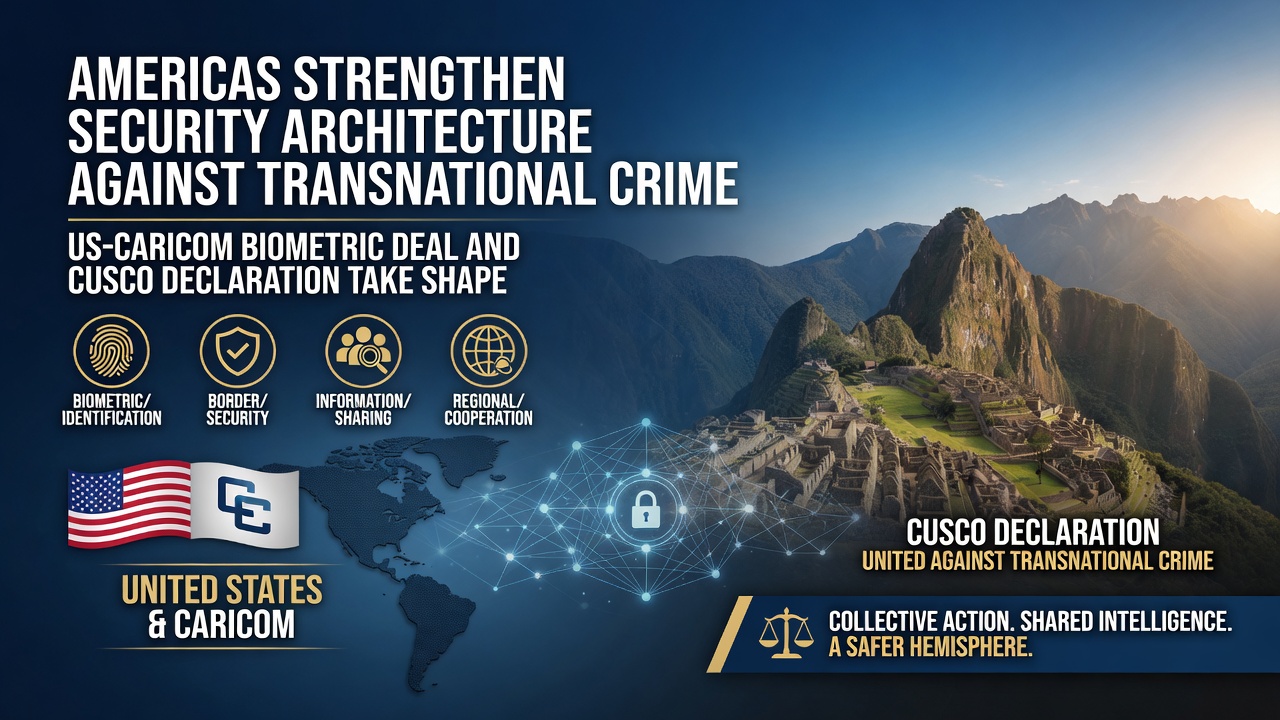

Kingston / Washington / Cusco — Within the space of a few days, governments across the Americas have taken two significant steps that together signal a more coordinated regional response to transnational organised crime. One provides a practical new tool for identifying security threats, while the other establishes a shared political commitment to deeper defence and security cooperation.
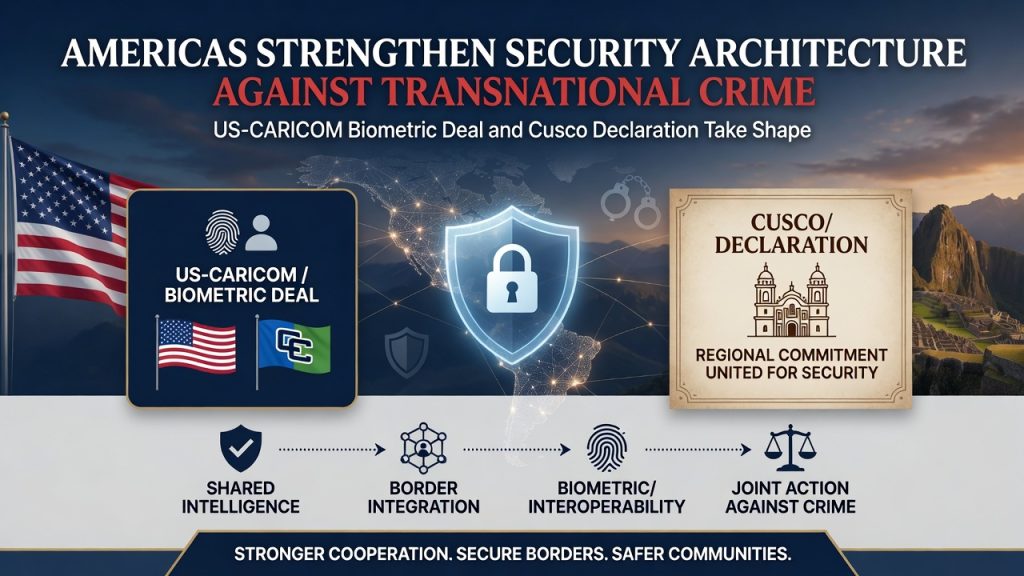
On 10 July, the United States Department of Homeland Security (DHS) and the Caribbean Community Implementation Agency for Crime and Security (CARICOM IMPACS) signed a Memorandum of Cooperation establishing the Biometric Data Sharing Partnership (BDSP). US officials described the agreement as the Department’s first multilateral biometric information-sharing arrangement with regional partners.
Only days earlier, from 7–10 July, defence ministers and senior security officials representing more than 30 countries gathered in Cusco, Peru, for the 17th Conference of Defence Ministers of the Americas, concluding with the adoption of the Cusco Declaration. The declaration commits countries across the hemisphere to strengthen cooperation against transnational organised crime, terrorism, illicit financial networks, cyber threats and other emerging security challenges.
Although negotiated independently, the two initiatives complement one another by combining operational capabilities with broader political commitments, reflecting a growing recognition that criminal organisations now operate across borders with increasing sophistication and cannot be effectively confronted by individual states acting alone.
A New Layer of Border Security
The Biometric Data Sharing Partnership establishes a framework through which participating countries can securely exchange biometric and associated biographical information to assist in screening, vetting, and investigating individuals who may pose security or immigration risks.
The agreement was signed at the Embassy of Saint Kitts and Nevis in Washington, D.C., by Rob Law, DHS Under Secretary for Strategy, Policy, and Plans, and Lieutenant Colonel Michael Jones, Executive Director of CARICOM IMPACS.
Initially, the partnership will involve six Organisation of Eastern Caribbean States (OECS) members—Antigua and Barbuda, Dominica, Grenada, Saint Kitts and Nevis, Saint Lucia, and Saint Vincent and the Grenadines—with particular attention given to strengthening vetting procedures associated with Citizenship-by-Investment (CBI) programmes.
“This will strengthen cooperation between DHS and CARICOM IMPACS on border security and immigration vetting,” Law said during the signing ceremony.
According to the US State Department, the arrangement helps close what it described as “a critical gap in the Western Hemisphere’s security architecture.” Officials emphasised that the agreement does not alter existing visa policies but instead improves the ability of participating governments to verify identities, detect fraud, and identify persons linked to criminal or security concerns.
The partnership is expected to become operational before the end of 2026, with automated biometric exchanges anticipated within months.
Cusco Declaration Broadens Hemispheric Cooperation
While the biometric agreement focuses on operational information-sharing, the Cusco Declaration establishes a wider strategic framework for defence and security cooperation throughout the Americas.
Speaking on behalf of Prime Minister Dr. Andrew Holness during the Cusco conference, Jamaica’s Deputy Prime Minister and Minister of National Security, Dr. Horace Chang, warned that criminal organisations continue to exploit weaknesses in regional security systems.
“Transnational criminal organisations are also evolving, exploiting porous borders to traffic narcotics, illegal firearms and persons while facilitating money laundering and other forms of organised crime,” Dr. Chang told delegates.
He urged countries across the hemisphere to deepen intelligence sharing, expand joint military training and exercises, strengthen technical cooperation and modernise legal frameworks to improve investigations and prosecutions involving cross-border criminal networks.
The resulting declaration commits participating nations to enhancing collective action against organised crime while also expanding cooperation in humanitarian assistance, disaster response and other regional security priorities.
The United States played an active role throughout the conference, reinforcing Washington’s continuing emphasis on hemispheric security partnerships.
Operational Tools Meet Strategic Vision
Viewed together, the two developments illustrate complementary approaches to addressing the same set of evolving threats.
The BDSP provides a practical mechanism for verifying identities, detecting fraudulent documentation, and strengthening border screening through biometric technology. The Cusco Declaration, meanwhile, supplies the broader political framework needed to encourage intelligence sharing, defence cooperation, and coordinated policy development across the hemisphere.
For Caribbean nations, the convergence is particularly significant.
The region’s geographic location places it along major narcotics trafficking routes, while its extensive maritime borders present continuing challenges for law enforcement. Criminal organisations increasingly operate across multiple jurisdictions, combining drug trafficking, firearms smuggling, human trafficking, cybercrime, and money laundering into sophisticated transnational networks.
Countries that depend heavily on tourism, international travel, and legitimate trade therefore face the dual challenge of maintaining open economies while protecting national security.
Jamaica has already been investing in practical measures to strengthen maritime security, including modernising the Jamaica Defence Force Coast Guard through the acquisition of offshore patrol vessels designed to improve surveillance and law enforcement across its territorial waters.
Challenges Ahead
Despite the momentum generated by both initiatives, implementation will ultimately determine their effectiveness.
The biometric partnership must establish reliable technical interoperability between participating countries while maintaining robust safeguards for data protection, privacy, and the prevention of erroneous matches or misuse of sensitive personal information.
Likewise, the aspirations contained in the Cusco Declaration will require sustained political commitment, adequate funding, stronger institutional capacity—particularly among smaller Caribbean states—and effective mechanisms for monitoring implementation.
Regional leaders have consistently emphasised that stronger security cooperation must be balanced with respect for national sovereignty, the rule of law, and the protection of individual rights. Privacy advocates and data protection authorities across the Caribbean are expected to scrutinise how biometric information is collected, stored, shared, and safeguarded under the new framework.
Looking Ahead
Taken together, the Biometric Data Sharing Partnership and the Cusco Declaration represent one of the most significant advances in hemispheric security cooperation in recent years.
One delivers a tangible operational capability designed to strengthen identity verification and border security. The other provides a strategic roadmap for deeper defence collaboration across the Americas.
If effectively implemented, these parallel initiatives could significantly enhance the region’s ability to disrupt organised criminal networks, improve border integrity, and strengthen public security. For Caribbean governments, success will ultimately be measured not by the signing of agreements, but by whether enhanced cooperation leads to safer communities, stronger institutions, and greater economic resilience throughout the region.