







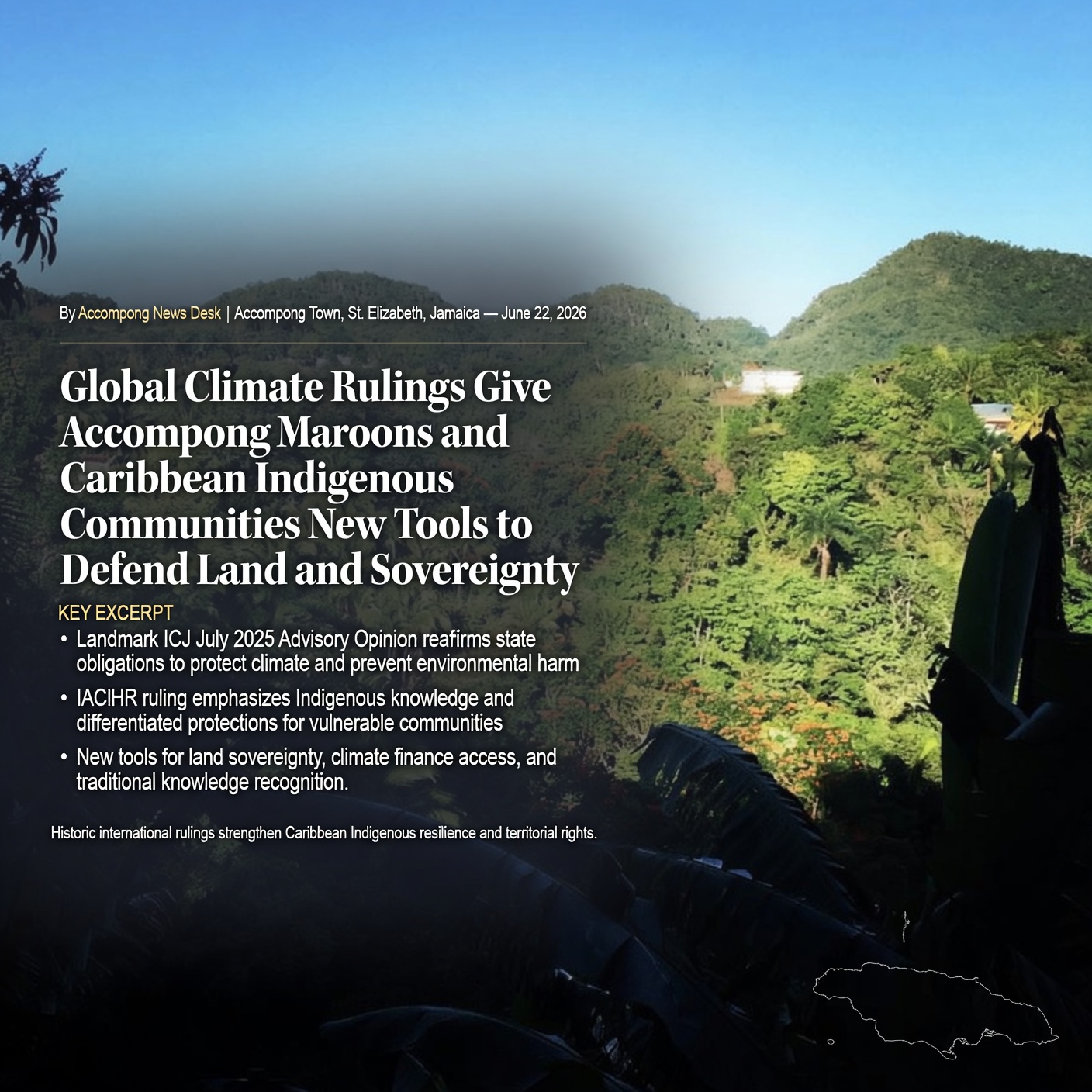
Historic international climate rulings are providing Indigenous and traditional communities with powerful new arguments to defend their lands, seek climate justice, and hold governments accountable. For the Maroons of Accompong, whose treaty lands lie within Jamaica’s Cockpit Country, the developments could strengthen efforts to protect both sovereignty and territory as climate change increasingly threatens vulnerable communities across the Caribbean.
One month after the United Nations General Assembly adopted a landmark resolution supporting the International Court of Justice’s advisory opinion on climate obligations, communities throughout the region are assessing what these global legal developments mean for their local realities.
The ICJ’s July 2025 advisory opinion affirmed that states have binding obligations under international law to protect the climate system, prevent environmental harm, pursue ambitious emissions reductions, and cooperate on adaptation and loss-and-damage measures. A complementary ruling from the Inter-American Court of Human Rights reinforced the need for a transition away from fossil fuels while recognising the importance of Indigenous knowledge in climate policy.
At the United Nations Permanent Forum on Indigenous Issues earlier this year, Indigenous leaders emphasised that these rulings are not merely symbolic declarations but practical tools that communities can use to advance their rights and protect their territories.
Jamaica joined Barbados, Vanuatu, and other nations in supporting the May 2026 UN General Assembly resolution, placing the country among a growing coalition seeking greater international climate accountability. For Accompong and other traditional communities, however, the challenge lies not in what international courts have declared, but in how those principles are translated into meaningful protections on the ground.
Climate Change and the Future of Accompong
Located in the rugged limestone hills of Cockpit Country, Accompong occupies territory that is increasingly significant in a region facing rising seas, stronger storms, and growing climate uncertainty.
While many Caribbean communities confront coastal flooding and erosion, Accompong’s highland location offers a degree of natural protection. Yet the community is not immune to climate impacts. More intense hurricanes, changing rainfall patterns, landslides, droughts, and agricultural disruption threaten food security, water supplies, and traditional livelihoods.
The forests surrounding Accompong also play a critical role as carbon sinks and natural defences against flooding and erosion. Any weakening of environmental protections, including renewed pressure for mining or other extractive activities within or near Cockpit Country, would threaten not only biodiversity but the cultural and spiritual connection Maroons maintain with their ancestral lands.
For a people whose identity, governance, and history are deeply tied to territory secured under the 1739 treaty, climate resilience is inseparable from land protection.
New Opportunities for Climate Justice
The emerging international legal framework offers several potential opportunities for Accompong and other Indigenous and traditional communities.
Access to Climate Finance and Loss-and-Damage Funding
The rulings strengthen arguments that countries most responsible for historical greenhouse gas emissions should contribute to addressing climate-related losses suffered by vulnerable communities.
For Caribbean nations and communities, this could strengthen efforts to secure funding for resilient infrastructure, ecosystem restoration, sustainable agriculture, and cultural preservation initiatives. Community leaders may also advocate for mechanisms that allow local communities to access climate funding directly while maintaining autonomy over how those resources are used.
Recognition of Traditional Knowledge
The international rulings place new emphasis on incorporating Indigenous and traditional ecological knowledge into climate policy and adaptation planning.
For Maroon communities, whose land-management practices have evolved over centuries, this creates opportunities to push for greater recognition of local expertise in Jamaica’s climate strategies.
The Yamaye Council of Indigenous Leaders (YCOIL), which brings together Maroon communities and Yamaye representatives, could play an important role in advocating for the inclusion of traditional knowledge in national climate planning and environmental management.
Strengthening Land and Territorial Protections
The ICJ’s emphasis on preventing environmental harm and exercising due diligence may provide additional support for efforts to protect Cockpit Country from activities that threaten its ecological integrity.
Combined with broader advocacy for recognition of Indigenous and Maroon rights, including support for the principles contained in the United Nations Declaration on the Rights of Indigenous Peoples, the rulings add international weight to arguments that communities should have meaningful participation in decisions affecting their ancestral lands.
Expanding International Advocacy
International forums such as the UN Permanent Forum on Indigenous Issues and mechanisms linked to the UN Special Rapporteur on the Rights of Indigenous Peoples provide opportunities for Caribbean communities to build alliances with Indigenous peoples around the world.
These platforms can help elevate local concerns to the international stage while sharing successful strategies for defending land rights and advancing climate justice.
Caribbean Communities Face Common Challenges
Accompong’s experience reflects broader realities across the Caribbean.
The Kalinago people of Dominica continue to confront the impacts of severe storms, coastal erosion, biodiversity loss, and changing weather patterns. Indigenous women and youth within the Kalinago Territory have become key leaders in sustainable agriculture and community resilience efforts.
Garifuna communities in Belize and Maroon communities in Suriname and Jamaica similarly face the challenge of preserving cultural traditions while adapting to a changing climate.
Across the region, communities often encounter a familiar pattern: strong legal protections on paper but inconsistent implementation in practice. This gap between commitments and action remains one of the greatest obstacles to achieving climate justice.
The Challenge of Enforcement
Despite their significance, international advisory opinions and UN resolutions do not automatically change domestic policy.
Their influence depends on political will, public advocacy, litigation, and sustained pressure from affected communities. Governments may endorse international principles while struggling to implement them due to financial constraints, institutional limitations, or competing development priorities.
For Jamaica and other Caribbean nations, balancing economic development, debt pressures, environmental protection, and climate resilience will remain a complex challenge.
For Accompong, the question is how to leverage these new international tools while preserving the autonomy and self-determination that have defined Maroon identity for generations.
From International Recognition to Local Action
The international courts have clarified what governments should do. The United Nations has reinforced those obligations. The responsibility now falls to states, institutions, and communities to ensure those commitments become reality.
For the Maroons of Accompong and Indigenous peoples across the Caribbean, climate change is not simply an environmental issue. It is a question of land, culture, governance, and survival.
The new rulings will not solve those challenges on their own. But they provide communities with stronger legal, political, and moral foundations from which to defend ancestral territories, secure climate justice, and shape their own futures.
The next chapter will not be written in international courtrooms alone. It will be determined by how effectively communities transform these global commitments into concrete protections for the lands and peoples they seek to preserve.