




Opinion
When disaster strikes, politics should take a back seat to people.
Whether the crisis is caused by a hurricane, flooding, or another national emergency, communities need immediate help—roads repaired, homes rebuilt, businesses supported, and essential services restored. Recovery is not simply another government programme; it is often the difference between hope and despair for thousands of families.
Against that reality, allegations that political actors may have sought to delay aspects of Jamaica’s National Reconstruction and Resilience Authority (NaRRA) programme deserve serious public scrutiny. If political strategy is ever allowed to outweigh the urgent needs of disaster victims, difficult ethical questions inevitably follow.
Recovery Is About People, Not Politics
Every delayed reconstruction project has a human face.
It may be a family still living under a temporary roof months after a hurricane. It may be a farmer unable to return to production because roads remain impassable. It may be a small business owner forced to close permanently while waiting for damaged infrastructure to be restored.
In disaster recovery, time has real consequences. Delays increase rebuilding costs, prolong economic hardship, and deepen emotional trauma for affected communities.
For that reason, any allegation that recovery programmes are being slowed primarily for political advantage deserves careful examination.
The Questions Raised by the Leaked Audio
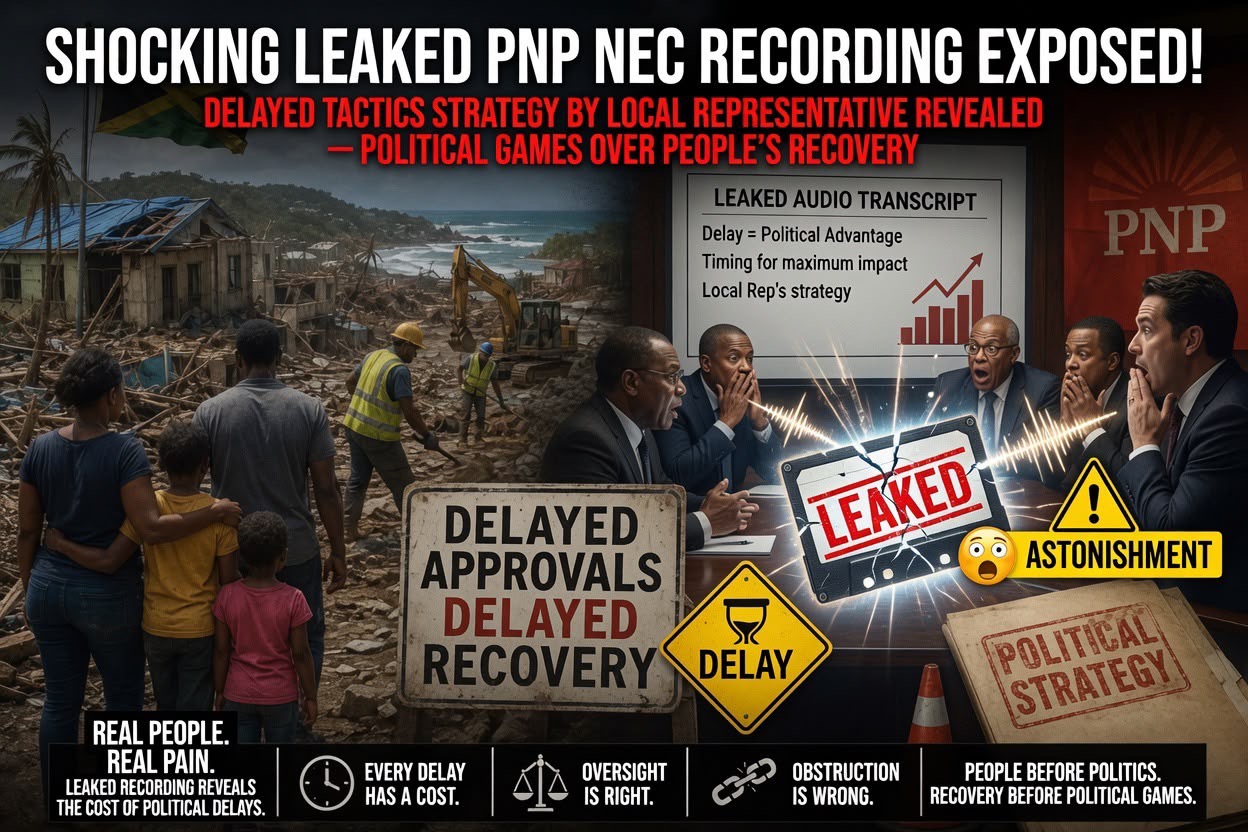
A leaked recording reportedly from a People’s National Party (PNP) National Executive Committee(WhatsApp Group) discussion has generated public debate about the role of parish councils in approving NaRRA-related projects.
According to reports of the recording, participants discussed parish council approval processes, concerns about safety standards, and the political implications of the government’s recovery programme. Portions of the discussion have been interpreted by critics as suggesting that delaying approvals could weaken the Jamaica Labour Party’s (JLP) political standing ahead of future elections.
The PNP has not publicly accepted the interpretation advanced by its political opponents, and the complete context of the discussion remains important when assessing the recording.
Nevertheless, if public officials intentionally use administrative processes primarily to deny disaster victims timely assistance for partisan gain, that would represent a serious breach of public trust.
Oversight Versus Obstruction
Opposition parties play an essential role in any democracy.
They are expected to scrutinise government spending, demand transparency, expose corruption where it exists, and ensure that public money is used responsibly. Disaster recovery programmes should never be exempt from accountability.
Concerns about construction standards, procurement practices, environmental impacts, or legal compliance are legitimate issues that deserve careful consideration.
The ethical line is crossed, however, if procedural tools are employed not because they improve outcomes, but because they slow projects that could politically benefit the governing party.
Oversight protects democracy.
Obstruction weakens it.
The Greatest Cost Falls on the Most Vulnerable
Political delays rarely affect everyone equally.
The poorest households often suffer the longest.
Small farmers lose another growing season.
Children continue attending damaged schools.
Businesses postpone hiring.
Communities remain vulnerable to the next storm before recovering from the last.
In a country as exposed to natural disasters as Jamaica, resilience depends on governments, local authorities, and opposition representatives recognising that disaster recovery cannot become another arena for partisan warfare.
Restoring Public Confidence
Regardless of political affiliation, Jamaicans deserve confidence that recovery programmes are guided by need rather than electoral calculations.
That confidence can be strengthened through:
- transparent reporting of NaRRA projects;
- independent financial and performance audits;
- clearly published approval timelines;
- public explanations for significant project delays; and
- bipartisan oversight that promotes accountability without unnecessarily delaying recovery.
These measures would protect both transparency and efficiency while reducing opportunities for political mistrust.
Leadership During National Crisis
Disasters test more than infrastructure.
They test leadership.
They reveal whether elected officials place citizens ahead of party interests.
If allegations of politically motivated delay are ever substantiated, they would represent more than a tactical political decision—they would raise fundamental questions about public service and democratic responsibility.
Equally, if concerns raised by opposition representatives are genuinely rooted in safety, legality, or good governance, those concerns should be addressed openly and transparently rather than dismissed as partisan obstruction.
Ultimately, disaster recovery should never be measured by which party receives political credit. It should be measured by how quickly families return home, businesses reopen, schools recover, and communities rebuild.
The Jamaican people deserve a recovery process driven by urgency, accountability, and cooperation—not one overshadowed by partisan competition.