





By Darius Reed, Accompong News | June 17, 2026
Jamaica is celebrating a historic drop in murders. The government says so. The statistics say so. And by almost every national measure, 2026 is shaping up to be the safest year the island has seen in a generation.
St. James(the parish) — and the constituency of the very man responsible for national security — the bodies keep piling up.
The minister answerable for it called the one tool that could bring accountability a “crazy idea.”
St. James: The Exception That Exposes Everything
As of May 31, Jamaica’s murder tally stood at 221 — a 23 per cent decline compared with the same period last year. But St. James recorded the highest number of murders nationally: 30 homicides, a 36 per cent increase over the corresponding period in 2025. Jamaica Gleaner
Read that again. The island goes down. St. James goes up — by more than a third.
Jamaica recorded 673 murders in all of 2025, a significant decrease compared to 1,147 in 2024 and 1,406 in 2023 — the first time the country recorded fewer than 1,000 murders since 2003. That is a genuine achievement, and Accompong News credits it as such. Jamaica Gleaner
But those numbers are a national average. They paper over what is happening in the west. St. James is not sharing in Jamaica’s peace dividend. It is hemorrhaging.
The Police Killing Surge Nobody Wants to Talk About
Set aside civilian murders for a moment. There is a second set of numbers — numbers the government celebrates far less publicly.
In 2025, INDECOM investigated 311 fatal shootings of persons by members of the security forces — the highest figure recorded since 2010, representing an increase of approximately 65 per cent over the previous year. Planned police operations accounted for approximately 50 per cent of those fatalities. Jamaica Gleaner
Since the start of 2026, 105 persons have already been shot and killed by members of the security forces, compared with 102 at the same period last year. If 2025 saw the highest rate in close to 15 years, the question becomes: what will 2026 bring? Jamaica Gleaner
These are not criminals shot in spontaneous confrontations. Half of them — half — died in planned operations. Operations where officers knew they were going in. Operations where cameras could have been switched on before a single shot was fired.
They were not.
INDECOM’s own investigations found that in 252 fatal and non-fatal shooting incidents, not a single body-worn camera was activated — not one. And when cameras were present, they were conveniently turned off. Jamaica Observer
The Minister’s Answer: “A Crazy Idea”
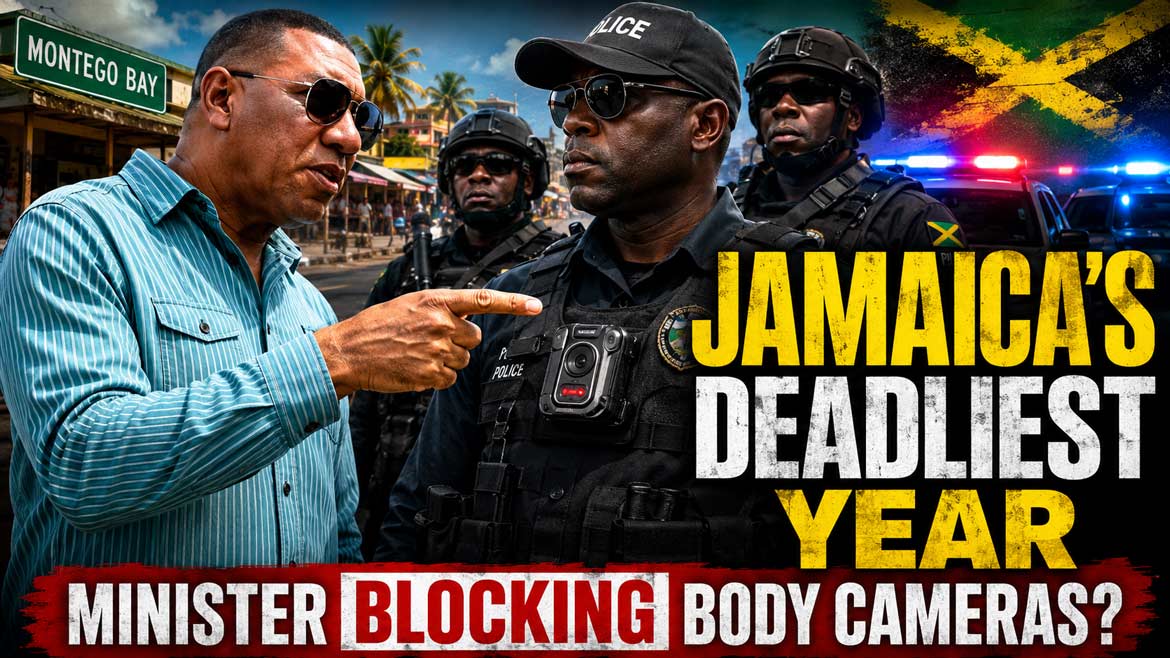
On April 22, 2026, National Security Minister Dr. Horace Chang stood at a post-Cabinet press conference and delivered his verdict on body-worn cameras for officers conducting planned operations against armed suspects.
“This thing that you must wear a camera when you going to look for a man who has a M16 that’s firing 60 rounds per second is a crazy idea,” he declared. Jamaica Observer
Chang argued that cameras would make officers targets. That the hunted moves faster than the hunter. That deploying a special squad with visible equipment compromises the mission.
What he did not explain is why that logic applies only to Jamaica.
A former deputy commissioner of police and leading human rights groups immediately pushed back, saying Chang’s position is not supported by global evidence. Jamaicans for Justice noted that police departments across the United States have demonstrated that body cameras on operations do not compromise officer safety. Jamaica Observer
INDECOM itself weighed in, stating that characterising body camera use in planned operations as unreasonable or impractical is inconsistent with established international policing practice — and that accountability and operational effectiveness are not opposites. Jamaica Gleaner
A Cabinet Divided — Or Is It?
The contradiction runs deeper than one minister’s press conference.
Prime Minister Andrew Holness stated publicly as recently as January 21, 2026, that body-worn cameras are not optional and that the government would provide the necessary budgetary support to ensure all formations requiring cameras are adequately equipped. Jamaica Observer
When Holness later addressed a police graduation ceremony in May 2026, his remarks were widely interpreted as a direct rebuke of Chang — who had by then publicly declared that cameras would not be used on armed operations. Jamaica Observer
A coalition of civil society organisations put the contradiction plainly: a Cabinet cannot hold two positions simultaneously, and the sustained silence from the Prime Minister’s Office in the face of that contradiction can only be interpreted as tacit endorsement — suggesting that the Deputy Prime Minister speaks for the entire Cabinet. Jamaica Gleaner
The Prime Minister says cameras are not optional. His Deputy says deploying them is crazy. Somewhere between those two positions, 311 people were killed in 2025 and nobody turned on a camera.
The Accompong Lens
Accompong News is not a Kingston outlet. We are not embedded in the press gallery at Jamaica House. We report from treaty land — from a community that has known for nearly 300 years what it means when the state decides which communities deserve protection and which deserve suppression.
St. James is not an abstraction to us. The Maroon territories of the west have watched that parish’s violence cycles for generations. We know what it looks like when government accountability stops at certain borders.
Horace Chang is the Member of Parliament for St. James North West. The parish recording Jamaica’s worst murder numbers in 2026 is his constituency. The officers conducting planned operations with no cameras rolling — his ministry’s policy permits that. The 311 people killed by security forces in 2025 — his tenure, his record, his responsibility.
A camera does not fire a weapon. It records what happens when one does. The only people who have a reason to fear that recording are the people who know the recording would not support their account.
What Accountability Looks Like
Opposition Senator Allan Bernard has proposed a digital accountability framework that would include a statutory body-worn camera policy for the JCF, noting that the government cannot preach digital trust while resisting the very technologies that would help citizens trust the state. “The Government cannot say Jamaica needs a trusted digital society while resisting the very technologies that would help citizens trust the State,” he said. Jamaica Observer
That is not a partisan position. It is a logical one.
Body cameras do not replace justice. They make it possible.