




DAKAR, Senegal — Senegal’s political crisis deepened this week as former Prime Minister Ousmane Sonko mounted a swift political comeback days after being dismissed by President Bassirou Diomaye Faye, setting the stage for a potentially prolonged power struggle at the highest levels of government.
The dramatic fallout between the two men, once allies who jointly spearheaded Senegal’s 2024 political transformation, has exposed growing divisions within the ruling PASTEF party and raised concerns about the future stability of one of West Africa’s most respected democracies.
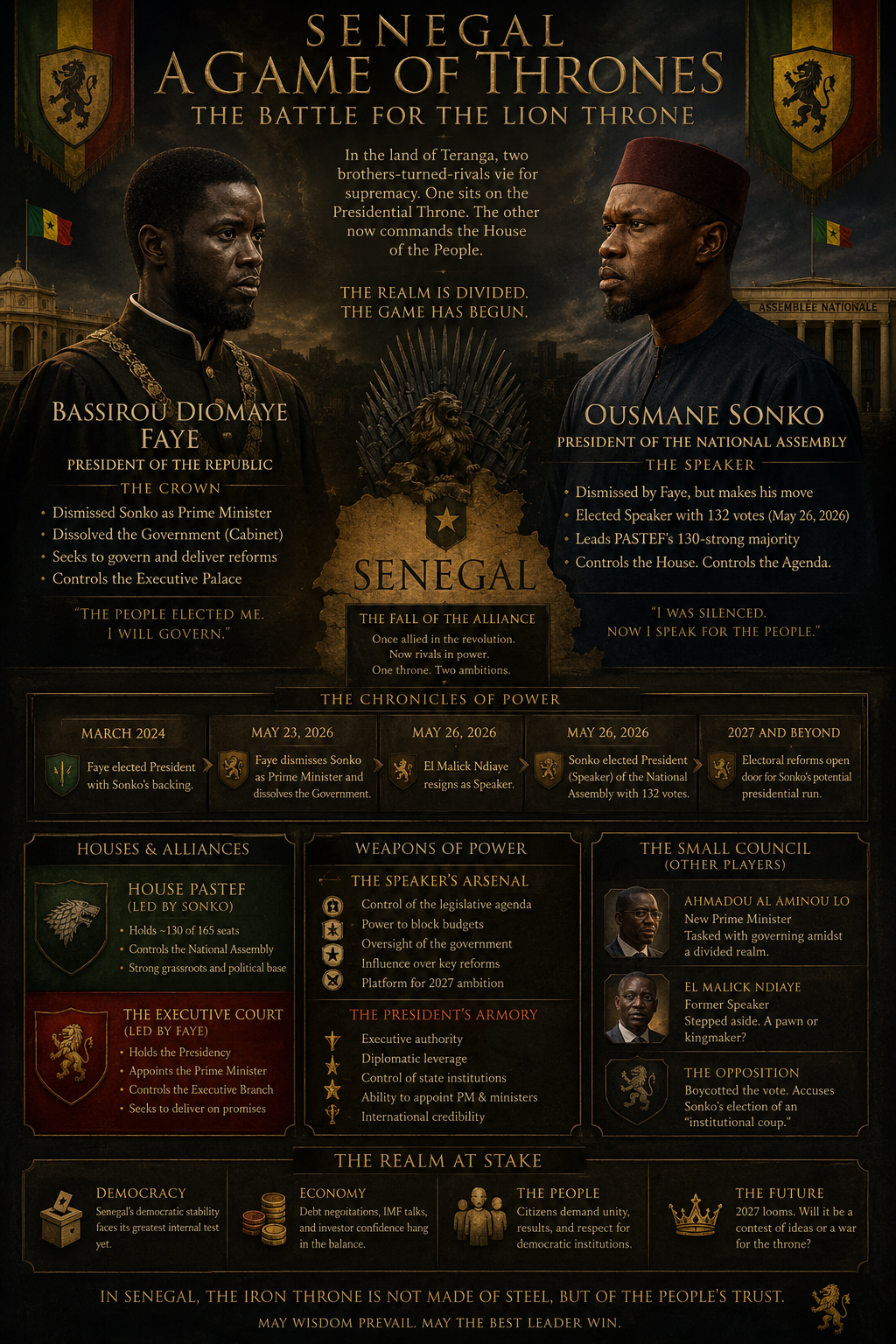
President Faye recently removed Sonko from the post of prime minister and dissolved the government, citing the need to restore effective governance. However, Sonko wasted little time re-establishing his political influence.
On May 26, lawmakers elected Sonko as President of the National Assembly after Speaker El Malick Ndiaye resigned from the position. Sonko secured 132 votes, backed by PASTEF’s overwhelming parliamentary majority, while opposition legislators boycotted the vote, denouncing the move as an “institutional coup.”
The election places Sonko at the head of Senegal’s legislature and gives him control over a powerful institution capable of shaping the country’s political agenda. With PASTEF holding approximately 130 of the National Assembly’s 165 seats, Sonko is expected to wield significant influence over legislation, government spending, and policy initiatives proposed by President Faye’s administration.
Political analysts say the development effectively creates a rival power centre within the state, with Sonko now positioned to challenge or constrain the president’s agenda from within parliament.
Unlike many political crises in the region, Senegal’s current turmoil is not driven by military intervention or opposition unrest. Instead, it stems from a bitter dispute between the two figures who once campaigned side by side under a shared reform platform.
The conflict could have major implications for Senegal’s economic programme, including ongoing efforts to address public debt concerns and negotiate with international financial institutions. Observers warn that prolonged institutional deadlock may undermine investor confidence and slow critical reforms.
The political stakes are expected to rise further after recent electoral reforms opened a pathway for Sonko to contest future presidential elections. Many analysts believe his move to parliament could serve as a platform from which to challenge President Faye’s leadership ahead of the next presidential race.
For now, Senegal finds itself at a crossroads, with the relationship between its president and former prime minister deteriorating into an open contest for political influence. As both leaders seek to consolidate power, the resilience of the country’s democratic institutions may face one of their most significant tests in recent history.