






INVESTIGATION
How a railway, a port, a redrawn boundary, and ten foreign mining companies connect to form a single extraction system — with Maroon land at the centre.
28 May 2026 · Accompong News Editorial Desk
⚠ EDITORIAL CORRECTION — 30 May 2026
An earlier version of this article stated that the Cockpit Country Protected Area had never been gazetted into law. This was incorrect. The CCPA was gazetted on March 17, 2022, under the Natural Resources Conservation (Cockpit Country Protected Area) Order, 2022, at 78,024 hectares — five years after the original 2017 announcement.
The article has been corrected to reflect this. The core findings of this investigation are unaffected: the gazetted CCPA remains the smallest of all proposed boundaries (78,024 hectares versus the community-endorsed 116,218 hectares), it excludes every Maroon community, and the mining leases documented in this report — including JISCO’s SEPL 643, which crosses the CCPA boundary into Maroon territory — were issued in 2021, before the CCPA had legal force.
Accompong News is committed to accuracy. When we make errors, we correct them publicly and promptly.
On May 27, 2026, Jamaica Gleaner columnist Norris R. McDonald published an article titled “Maroons, Minerals and Jamaica’s Symbolic Nationalism.” In it, he named what many in Accompong have known for years: that Jamaica practices a nationalism that roars against its own indigenous communities while whispering to foreign mining companies that the land is open for business. What McDonald describes as a contradiction, this investigation reveals as a system — one with rails, ports, leases, and a paper trail that connects Kingston harbour to the heart of the Cockpit Country.
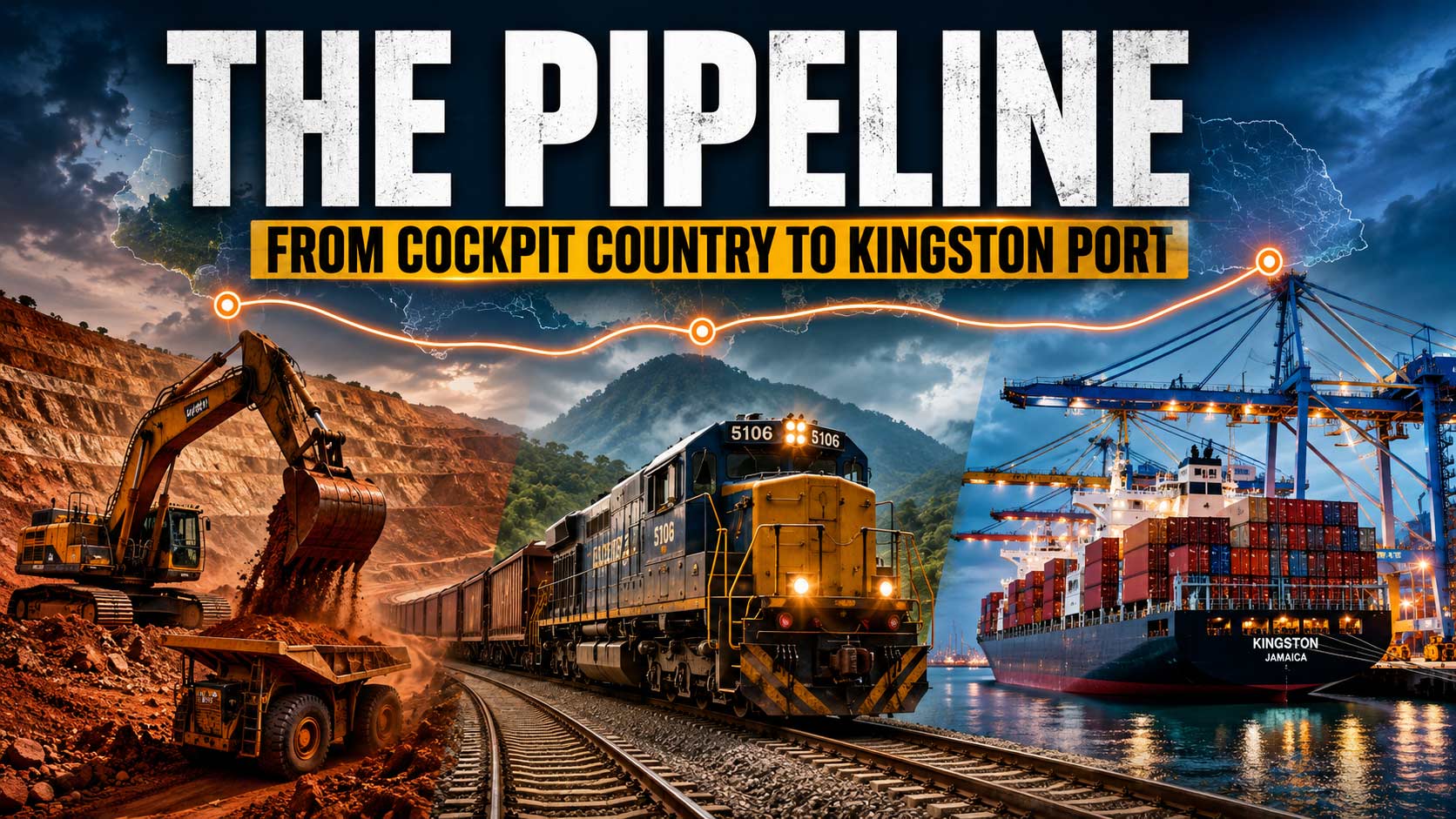
This is not a story about trains. It is not a story about bauxite or lithium or gold, though all three are present. This is a story about a pipeline — an integrated extraction infrastructure that begins beneath Maroon soil and ends on Chinese cargo ships. The railway is the last piece. When it is built, the system will be complete.
Part I — The Boundary Game
In November 2017, Prime Minister Andrew Holness stood in Parliament and announced the Cockpit Country Protected Area. He designated approximately 74,726 hectares and declared the area closed to mining. It was celebrated as a victory. It was not.
There were three proposed boundaries for Cockpit Country. The Cockpit Country Stakeholders Group boundary was the largest — it included every Maroon community: Accompong, Maroon Town, Cuffie Ridge, Quashies River Sink, Mahogany Hall. The geomorphological boundary, drawn in 2005, was smaller — and deliberately excluded every one of those Maroon communities. The government chose a boundary smaller still.
The Cockpit Country Protected Area (CCPA) was announced in November 2017 but was not gazetted into law until March 2022 — a five-year gap during which the boundary carried no legal protection. It was during that window, in 2021, that the government issued new mining leases to Noranda and a prospecting licence to JISCO that crosses into the CCPA boundary and Maroon land. The licences were granted before the protection existed in law. Even after gazetting, the CCPA remains the smallest of all proposed boundaries — 78,024 hectares against the community-endorsed 116,218 hectares. The 38,000-hectare difference excludes every Maroon community.
What the announcement created was a gap. Everything inside the small CCPA was symbolically protected. Everything outside — including Accompong Maroon lands and heritage sites — was left open. And it was into that gap that the mining leases flowed.
JISCO’s SEPL 643 prospecting licence crosses the CCPA boundary. It covers land belonging to the Accompong Maroons.
Part II — The Players
| Entity | Origin | Jamaica Operations |
|---|---|---|
| Noranda Bauxite | 🇺🇸 | 49% bauxite mining, St. Ann. Through 2030. |
| UC Rusal | 🇷🇺 | 100% WINDALCO — Ewarton & Kirkvine plants. Alumina trains running as of 2025. |
| JISCO | 🇨🇳 | Alpart refinery, Nain. SEPL 643 crosses CCPA into Maroon territory. |
| China Merchants Port | 🇨🇳 | 100% Kingston Freeport Terminal. 30-year concession. |
| CHEC | 🇨🇳 | $320M port expansion contract (2025). “Golden node” of Maritime Silk Road. |
| Barrick Gold | 🇨🇦 | Prospecting licences, Cockpit Country adjacent areas. |
Part III — The Port
China Merchants Port Holdings now exercises complete control — one hundred percent — over Kingston Freeport Terminal Limited, managing the Port of Kingston under a 30-year concession. The port handles more than 60% of cargo transit in the Caribbean.
In July 2025, CHEC won a $320 million contract to expand that same port. CHEC’s Caribbean general manager stated the project is part of a “port-park-city” strategy to build a “golden node of the China-Latin America Maritime Silk Road.”
On the Record — JISCO: JISCO’s assistant managing director stated publicly that mining bauxite at distant places such as “St Ann” and transporting it to the Nain refinery using “rail” would make JISCO more profitable. This statement was made in 2023. The railway has not yet been built.
Part IV — The Railway
Jamaica’s railway ran from Kingston to Montego Bay until 1992. Between Stonehenge and Ipswich, the line runs directly along the southern edge of Cockpit Country. After passenger service ceased, a 79-kilometre section remained open — exclusively for transporting alumina from UC Rusal’s Ewarton works to Port Esquivel. As recently as August 2025, Rusal was running trains on those tracks.
The railway revival plan specifically covers the Kingston–Montego Bay and Spanish Town–Ewarton lines, with China upgrading infrastructure with heavier rail and concrete sleepers, and providing five locomotives, 45 coaches, and 68 wagons. The Spanish Town–Ewarton line is the bauxite spur. It is included in the same package.
The flow: MINES (Noranda, JISCO, UC Rusal, Barrick) → RAIL (Chinese-upgraded infrastructure) → PORT (China Merchants / CHEC) → SHIPS → CHINA
The Question
The Accompong Maroons signed a treaty in 1738 — the oldest standing treaty in the Western Hemisphere. Their lands sit at the geographic centre of this pipeline. The boundary meant to protect their territory was drawn to exclude them. Mining licences were issued without their consent. A port was transferred to foreign control without their consultation. And a railway is being planned without their participation.
The CCSG boundary (largest) encompassed all Maroon communities. The government drew the CCPA (smallest) excluding them. The gap between is where mining leases were granted and the railway runs.
This is an ongoing investigation. Accompong News will continue to report.